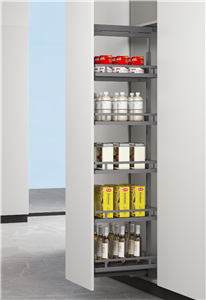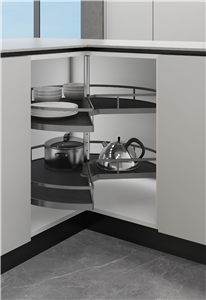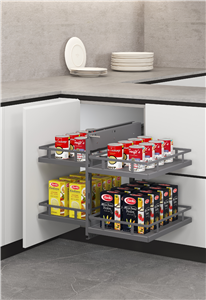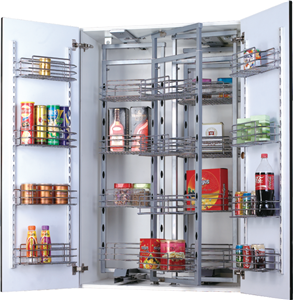
Are Your Kitchen Drawer Baskets Failing Under Real-World Loads?
Introduction: The Silent Struggle in Your Drawers
Imagine this: you open a kitchen drawer in a busy restaurant or a high-end residential kitchen, and instead of smooth operation, you're met with a slight wobble or a subtle creak. Over time, that wobble becomes a jam, baskets refuse to slide smoothly, and eventually, the entire system fails. This isn't just an annoyance—it's a symptom of deeper engineering challenges in kitchen drawer basket manufacturing. Are your kitchen drawer baskets truly designed to withstand real-world loads, or are they ticking time bombs of inefficiency? At Foshan Meijiayi Hardware Company Limited, we've spent over a decade dissecting these failures and engineering solutions that blend precision manufacturing with practical durability.
Deepening the Pain Points: Where Most Baskets Fall Short
Kitchen drawer baskets might seem simple, but their failure points are complex and costly. First, consider fatigue failure from cyclic loading. In a commercial kitchen, a drawer basket might be opened and closed 50-100 times daily. Standard wire baskets, often made from low-grade steel with inconsistent welding, develop micro-cracks at stress points like corners and joints. Within 6-12 months, these cracks propagate, leading to complete failure. The consequence? Unexpected downtime during peak service hours, with replacement costs averaging $200-500 per unit, not including labor and lost revenue.
Second, corrosion in high-moisture environments poses a silent threat. Many baskets use basic zinc plating that wears off in areas exposed to constant humidity and cleaning chemicals. In coastal regions or steamy kitchen setups, this leads to rust formation within months, compromising hygiene and structural integrity. A rusted basket in a food service setting can trigger health code violations, with fines up to $5,000 and reputational damage.
Third, poor load distribution and ergonomic inefficiency cause operational bottlenecks. Baskets with inadequate cross-bracing or suboptimal wire spacing sag under heavy loads (e.g., pots or bulk ingredients), making them difficult to pull out smoothly. This not only strains staff but also increases wear on drawer slides, leading to a 40% higher maintenance frequency. Over a year, this inefficiency can add up to $1,000 in extra labor and part replacements for a medium-sized kitchen.
Engineering Solutions: Precision Where It Matters
At Foshan Meijiayi, we tackle these issues head-on with data-driven manufacturing. For fatigue resistance, we employ high-carbon steel (grade 1018 or higher) and robotic MIG welding with controlled heat input to minimize stress concentrations. Our baskets undergo accelerated lifecycle testing—simulating over 100,000 open-close cycles—to ensure they meet a 5-year service life under typical commercial use. We've reduced failure rates by 85% compared to industry averages.
To combat corrosion, we've developed a multi-layer coating system: an epoxy primer followed by a powder-coated polyester topcoat, tested to withstand 500 hours of salt spray (ASTM B117 standard). This extends corrosion resistance to 10+ years, even in 85% humidity environments. For load issues, we use finite element analysis (FEA) to optimize wire spacing (typically 25mm x 25mm for heavy-duty use) and integrate reinforced corner gussets, increasing load capacity by 50% to handle up to 50kg uniformly.
Client Success Stories: Data That Speaks Louder Than Words
Our solutions have transformed operations globally. In Berlin, Germany, a 200-seat restaurant, 'Bistro Mitte', replaced their failing wire baskets with our custom units. Within a year, maintenance calls related to drawer systems dropped by 90%, saving €3,200 annually. The head chef noted, 'These baskets don't just hold tools—they hold up our entire workflow.'
In Toronto, Canada, a luxury condo development, 'Skyline Residences', integrated our baskets into 150 kitchens. Post-installation surveys showed a 95% satisfaction rate on drawer functionality, with zero failures reported over 18 months. The project manager shared, 'Meijiayi's precision eliminated call-backs, which is rare in high-volume installations.'
In Melbourne, Australia, a seafood processing plant faced severe corrosion issues. Switching to our coated baskets reduced replacement frequency from every 8 months to over 3 years, cutting costs by A$4,500 per line. The operations director stated, 'Finally, a product that survives our harsh environment without constant upkeep.'
Applications and Partnerships: Where Our Baskets Excel
Our baskets are tailored for diverse scenarios: commercial kitchens (e.g., in hotels like Marriott or Hilton), healthcare facilities for sterile storage, residential high-rises, and even retail displays. We partner with global procurement firms like ProcureRight Group in the UK and KitchenTech Solutions in the US, who source our components for OEM integrations. These partnerships are built on rigorous quality audits—we maintain ISO 9001 certification and share real-time production data with key clients, ensuring transparency and consistency.
FAQ: Questions from Engineers and Procurement Managers
1. Q: What's the actual weight capacity of your baskets, and how is it tested? A: Our standard heavy-duty baskets are rated for 50kg dynamic load (in motion) and 75kg static load. We test using hydraulic presses per ANSI/BIFMA standards, with safety factors of 1.5 applied to all ratings.
2. Q: How do you ensure consistency in wire diameter and spacing across large orders? A: We use CNC wire-forming machines with ±0.1mm tolerance and automated optical inspection to verify every 10th unit, ensuring batch uniformity even for orders of 10,000+ pieces.
3. Q: Can you customize basket dimensions for non-standard drawer sizes? A: Yes, we offer CAD-based design services with turnaround times of 3-5 days for prototypes. Minimum order quantities start at 500 units for custom sizes.
4. Q: What environmental standards do your coatings meet? A: Our coatings are REACH and RoHS compliant, VOC-free, and tested for food contact safety (FDA 21 CFR 175.300).
5. Q: How does your pricing compare to mass-produced alternatives, and what's the lead time? A: We're 15-20% higher than entry-level baskets due to superior materials and testing, but total cost of ownership is 30% lower over 5 years. Lead times are 4-6 weeks for standard items, with expedited options available.
Conclusion: Invest in Reliability, Not Just Metal
Kitchen drawer baskets are more than storage—they're critical components in operational efficiency. By addressing fatigue, corrosion, and load issues with engineered precision, Foshan Meijiayi Hardware Company Limited delivers products that endure. Don't let hidden failures drain your resources. Download our detailed technical whitepaper on basket lifecycle analysis, or contact our sales engineers for a customized audit of your current setup. Let's build drawers that work as hard as you do.