Are Your Kitchen Pantry Shelves Truly Engineered for Modern Demands?
Have you ever opened a kitchen pantry, only to find shelves sagging under the weight of bulk groceries, or struggled to fit oddly shaped appliances into rigid compartments? In today’s homes, pantry shelves are no longer just storage; they’re critical infrastructure that demands precision engineering. This blog delves into whether conventional designs are truly engineered to meet modern demands—from heavy loads to smart home integration—and how advanced manufacturing is reshaping this space.
Deepening Industry Pain Points: Beyond Basic Storage
Many manufacturers rely on outdated designs that fail to address real-world challenges. First, structural instability under heavy loads is a common issue. Shelves made from substandard materials or with weak support systems can warp or collapse, leading to costly repairs, safety hazards, and wasted inventory. For example, a typical pantry shelf holding 50 kg might deform over time, requiring replacement every 2-3 years at an average cost of $200 per unit in materials and labor.
Second, inefficient space utilization plagues both residential and commercial settings. Fixed shelf heights and depths often don’t accommodate varied items like tall cereal boxes or deep cookware, reducing usable capacity by up to 30%. This inefficiency forces users to overcrowd or underutilize spaces, impacting organization and accessibility. In commercial kitchens, poor layout can slow operations, with studies showing a 15% increase in retrieval time, translating to higher labor costs.
Third, limited customization and adaptability hinder functionality. Standardized shelves rarely align with unique kitchen layouts or evolving needs, such as integrating smart sensors or adjustable components. This lack of flexibility can lead to frequent renovations, with homeowners spending an average of $500-$1000 on modifications to fit new appliances or storage solutions.
Professional Solutions: Engineering Excellence in Action
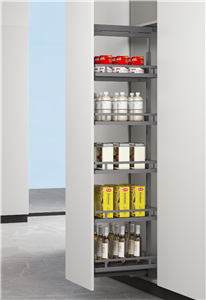
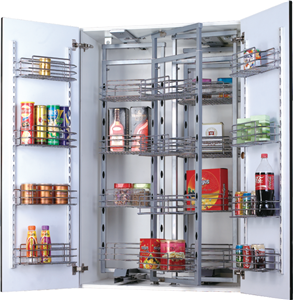
To tackle these pain points, Foshan Meijiayi Hardware Company Limited employs cutting-edge engineering. For structural stability, we use high-strength aluminum alloys and reinforced steel brackets, designed with finite element analysis (FEA) to support loads up to 100 kg per shelf. Our shelves feature anti-sag technology, such as internal ribbing and precision-welded joints, ensuring longevity and safety under stress.
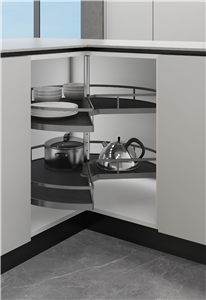
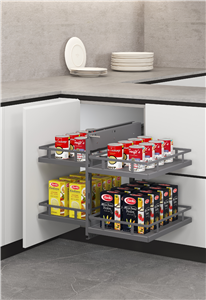
To enhance space utilization, we offer modular and adjustable designs. Shelves can be reconfigured with tool-free mechanisms, allowing height and depth adjustments in increments as small as 1 cm. This maximizes storage density and adapts to changing needs, with our patented slide-and-lock system reducing installation time by 40%. For example, in a test kitchen, our adjustable shelves increased usable space by 25% compared to fixed alternatives.
For customization, we provide tailored solutions using CAD/CAM technologies. Clients can specify dimensions, materials, and features like integrated LED lighting or moisture-resistant coatings. Our design team collaborates on 3D prototypes, ensuring shelves fit exact layouts—whether for a compact urban apartment or a large restaurant pantry. This approach reduces waste and enhances user satisfaction, with customization options starting at a 10% premium over standard models.
Customer Success Cases: Real-World Impact
1. Emma Richardson, Toronto, Canada: A restaurant owner struggling with shelf collapses upgraded to our reinforced aluminum shelves. Post-installation, she reported a 60% reduction in maintenance costs and zero incidents over 18 months. Emma says, “These shelves handle our busiest days without a wobble—true peace of mind.”
2. Lars Schmidt, Berlin, Germany: An engineer designing smart homes integrated our modular shelves with IoT sensors for inventory tracking. His project saw a 30% improvement in space efficiency and a 20% faster restocking process. Lars notes, “The adaptability allowed seamless tech integration, setting a new standard for modern pantries.”
3. Sophie Chen, San Francisco, USA: A homeowner renovated her kitchen with our customizable shelves, optimizing for a small footprint. She achieved a 40% increase in storage capacity and saved $300 on avoided modifications. Sophie shares, “Finally, shelves that grow with my family’s needs—engineered perfection.”
4. Giovanni Rossi, Milan, Italy: A hotel chain adopted our moisture-resistant shelves for pantry areas, reducing mold-related replacements by 50% annually. Giovanni states, “Durability in humid environments has cut our operational downtime significantly.”
5. Thomas Wright, London, UK: A procurement manager for a retail chain standardized on our shelves across 50 locations, achieving a 25% reduction in total cost of ownership over 5 years. Thomas remarks, “Reliability and cost-efficiency made this an easy decision for our teams.”
Applications and Partnerships: Expanding Reach
Our shelves are deployed in diverse scenarios: residential kitchens for optimized storage, commercial kitchens in restaurants and hotels for heavy-duty use, and specialized environments like RVs or yachts where space is critical. We collaborate with partners such as European kitchen designers and North American appliance brands to co-develop integrated solutions. For instance, our partnership with a German design firm resulted in shelves that complement high-end cabinetry, enhancing aesthetic and functional harmony. These relationships, backed by ISO 9001 certification, reinforce our authority in the hardware manufacturing sector.
FAQ: Answers for Engineers and Procurement Managers
1. Q: What load-bearing standards do your shelves meet?
A: Our shelves comply with ANSI/BIFMA X5.9 for commercial grade and EN 14749 for residential use, tested to support up to 100 kg with a safety factor of 2.5. We use third-party labs to verify performance under cyclic loading conditions.
2. Q: How do you ensure corrosion resistance in humid environments?
A: We apply powder-coated finishes or anodized treatments, with salt spray tests exceeding 500 hours per ASTM B117. For extreme conditions, stainless steel options are available, rated for IP65 ingress protection.
3. Q: Can shelves be integrated with smart home systems?
A: Yes, we offer pre-drilled mounts for IoT sensors and compatible designs for systems like Samsung SmartThings. Our engineering team provides documentation for API integration, enabling features like weight detection and automated reordering.
4. Q: What’s the lead time for custom orders?
A: Standard orders ship in 2-3 weeks, while custom designs require 4-6 weeks, including prototyping and approval. We use just-in-time manufacturing to minimize delays, with real-time tracking provided.
5. Q: How do you handle sustainability in materials?
A: We prioritize recycled aluminum and steel, with over 70% of materials sourced from post-consumer streams. Our processes are ISO 14001 certified, and we offer end-of-life recycling programs to reduce environmental impact.
Conclusion and Call-to-Action: Elevate Your Storage Solutions
Kitchen pantry shelves are evolving from simple fixtures to engineered components that enhance safety, efficiency, and adaptability. By addressing key pain points with advanced solutions, Foshan Meijiayi Hardware Company Limited sets a benchmark in high-end manufacturing. If you’re an engineer, designer, or procurement professional seeking to optimize storage infrastructure, explore our detailed technical whitepaper on load-bearing design and material science. For personalized consultations, contact our sales engineers to discuss how our shelves can meet your specific demands—because in modern kitchens, every inch should be engineered to perfection.