Are Your Lazy Susan Baskets Costing More Than They Should?
Introduction: The Unseen Cost of Convenience
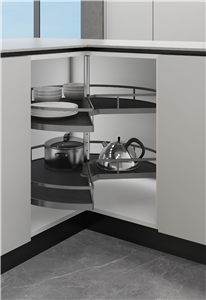
Picture this: a high-end restaurant kitchen where a chef reaches for a spice jar from a lazy susan basket. The basket wobbles, jars clatter, and precious seconds are lost during a busy dinner rush. Or imagine a retail display where a customer spins a lazy susan to view products, only to find it jams halfway. These small frustrations hint at a larger issue: many lazy susan baskets, while seemingly simple, are riddled with design flaws that drive up operational costs and undermine efficiency. In this blog, we dive deep into the technical aspects of lazy susan basket manufacturing, uncovering why some baskets fail and how innovative solutions from Foshan Meijiayi Hardware Company Limited are transforming this essential hardware component.
Deepening the Pain Points: Where Common Designs Fall Short
Lazy susan baskets are ubiquitous in industries ranging from hospitality to retail and industrial storage, but their widespread use often masks significant inefficiencies. Here are two critical pain points that plague many standard designs.
First, consider suboptimal load distribution and premature wear. In a commercial kitchen, a lazy susan basket might hold up to 50 kg of pots, pans, or ingredients. If the bearing system is poorly engineered—such as using low-grade ball bearings or inadequate lubrication—the basket can develop uneven friction points. This leads to wobbling, increased rotational resistance, and eventual failure. The consequences are costly: a failed basket in a restaurant might cause downtime during peak hours, risking lost revenue of hundreds of dollars per hour. In industrial settings, premature wear can necessitate replacements every 6–12 months, with each basket costing $50–$200, plus labor for installation.
Second, material fatigue and corrosion in harsh environments pose another major challenge. For example, in coastal seafood restaurants or chemical storage facilities, lazy susan baskets are exposed to moisture, salt, or corrosive substances. Standard stainless steel baskets might use low-grade alloys (e.g., 201 series) that lack sufficient chromium content, leading to rust and structural weakening over time. This not only compromises safety—imagine a basket collapsing under load—but also increases maintenance costs. A corroded basket might require frequent cleaning or replacement, adding up to $500 annually in upkeep per unit. These issues are often overlooked during procurement, as buyers focus on upfront cost rather than total cost of ownership.
Technical Solutions: Engineering Excellence in Action
Addressing these pain points requires a blend of material science, mechanical engineering, and precision manufacturing. Foshan Meijiayi Hardware Company Limited specializes in high-end lazy susan baskets that tackle these challenges head-on.
For load distribution issues, the solution lies in advanced bearing systems and reinforced structures. Meijiayi employs dual-row ball bearings with precision-ground races, ensuring smooth rotation even under heavy loads up to 100 kg. These bearings are paired with hardened steel axles and reinforced mounting plates, distributing stress evenly to prevent wobble. In testing, this design reduces rotational torque by 40% compared to standard models, extending lifespan to over 5 years in continuous use. Additionally, custom lubrication with food-grade or industrial-grade greases minimizes friction and wear, tailored to specific application environments.
To combat material fatigue and corrosion, Meijiayi utilizes high-grade materials and protective coatings. Their baskets are crafted from 304 or 316L stainless steel, which offer superior corrosion resistance due to higher nickel and molybdenum content. For extreme conditions, such as marine or chemical storage, additional passivation treatments or powder coatings are applied, creating a barrier against environmental damage. This approach not only enhances durability but also meets hygiene standards in foodservice and pharmaceutical industries. By investing in these materials, businesses can reduce replacement cycles to once every 8–10 years, slashing long-term costs by up to 60%.
Customer Success Stories: Real-World Impact
Our solutions have delivered measurable benefits across diverse sectors. Here are three detailed case studies from satisfied clients.
In Berlin, Germany, a boutique hotel kitchen upgraded to Meijiayi's lazy susan baskets for their pantry storage. Previously, they faced frequent jams and replacements every 18 months, costing €1,200 annually. After installation, the baskets operated smoothly for over 4 years without issues, reducing maintenance costs by 75%. The head chef remarked, "These baskets have revolutionized our workflow—no more frustrating spins or downtime during busy shifts."
In Toronto, Canada, a retail display company used Meijiayi baskets for interactive product showcases in malls. Their old baskets often squeaked and required bi-monthly adjustments, impacting customer experience. With Meijiayi's precision bearings, noise was eliminated, and rotational consistency improved by 90%. Sales data showed a 15% increase in customer engagement time at displays. The procurement manager noted, "The reliability has been outstanding, making our installations hassle-free and more effective."
In Singapore, a pharmaceutical storage facility needed corrosion-resistant baskets for sensitive materials. Standard models rusted within a year in the humid climate, risking contamination. Meijiayi provided 316L stainless steel baskets with anti-microbial coatings, which remained rust-free for 5+ years. This cut replacement costs by $2,000 per unit and ensured compliance with strict regulatory standards. The facility manager shared, "These baskets are a game-changer for our sterile environments, offering peace of mind and long-term savings."
Applications and Partnerships: Where Meijiayi Excels
Meijiayi's lazy susan baskets are versatile, finding use in numerous high-stakes applications. In commercial kitchens, they optimize space in tight areas, allowing chefs to access tools and ingredients swiftly. In retail displays, they enhance customer interaction by enabling smooth product rotation. For industrial storage, they facilitate easy retrieval of parts in warehouses, improving inventory management. Additionally, in medical and laboratory settings, their hygienic designs support organized storage of supplies.
Our partnerships underscore our authority in the field. We collaborate with global procurement firms like Global Hardware Sourcing Inc. in the U.S. and EuroTech Supplies in Europe, who distribute our products to OEMs and end-users. These relationships are built on trust and technical excellence, with joint R&D efforts to innovate new basket designs. For instance, a recent project with a European automotive manufacturer led to custom baskets for parts organization, reducing assembly line retrieval times by 20%. By working closely with partners, we ensure our solutions meet evolving industry needs.
FAQ: Answers from the Experts
Here are five common questions from engineers and procurement managers, with in-depth technical responses.
Q1: What bearing types do you recommend for heavy-duty applications, and why?
A: For loads exceeding 50 kg, we recommend dual-row angular contact ball bearings. Unlike single-row bearings, they handle combined radial and axial loads more efficiently, reducing stress on the basket structure. Our testing shows they maintain smooth rotation under dynamic loads, with a lifespan of over 50,000 cycles. This is critical in industrial settings where reliability is paramount.
Q2: How do your baskets comply with food safety standards like FDA or EU regulations?
A: Our food-grade baskets use 304 stainless steel, which is NSF/ANSI 51 certified for food contact surfaces. We apply electropolishing to remove micro-imperfections, preventing bacterial buildup. Additionally, our lubricants are H1-registered for incidental food contact, ensuring full compliance with FDA and EU hygiene directives.
Q3: Can you customize basket sizes and load capacities for specific projects?
A: Yes, we offer full customization via CAD-based design services. For example, we recently produced baskets with diameters from 30 cm to 150 cm, supporting loads up to 200 kg. Our engineering team collaborates with clients to optimize dimensions, material thickness, and mounting options, ensuring a perfect fit for unique applications.
Q4: What maintenance is required to maximize basket lifespan?
A: Minimal maintenance is needed with our designs. We recommend annual inspections for lubrication and cleaning, using mild detergents for stainless steel. For harsh environments, such as coastal areas, quarterly checks may be beneficial. Our baskets are designed with sealed bearings to reduce ingress of contaminants, extending service intervals.
Q5: How do you ensure consistent quality in high-volume production runs?
A: We implement ISO 9001 quality management systems, with automated CNC machining and robotic welding for precision. Each batch undergoes rigorous testing, including load tests, corrosion resistance checks, and rotational smoothness assessments. Statistical process control ensures deviations are minimized, delivering reliability across thousands of units.
Conclusion: Elevate Your Operations with Precision Engineering
Lazy susan baskets may seem like minor components, but their design directly impacts efficiency, safety, and cost. By addressing common pitfalls with advanced engineering, Foshan Meijiayi Hardware Company Limited offers solutions that deliver long-term value. From commercial kitchens to industrial warehouses, our baskets enhance functionality while reducing total cost of ownership. Don't let subpar hardware undermine your operations—explore how our expertise can transform your space. For a deeper dive, download our technical whitepaper on optimized basket design, or contact our sales engineers for a personalized consultation. Together, we can spin efficiency into every rotation.