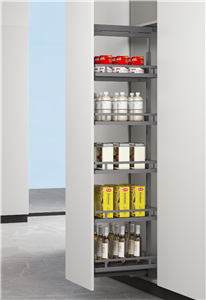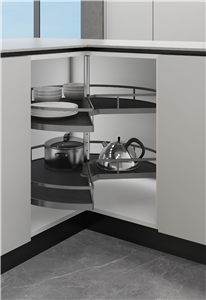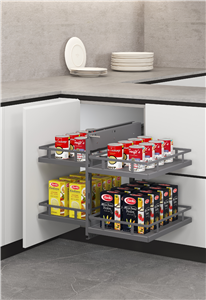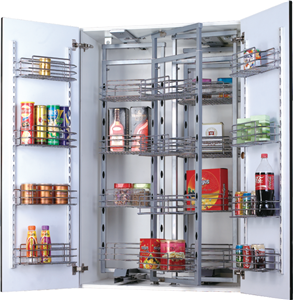
Are Your Pull-out Bottom Units Costing You Thousands in Downtime?
Imagine a busy assembly line in a German automotive plant. A pull-out bottom unit jams, halting production for 45 minutes. The cost: €12,000 in lost output. Sound familiar? If your pull-out bottom units are failing, you're not alone—but you don't have to accept it. At Foshan Meijiayi Hardware Company Limited, we've engineered a solution that reduces failure rates by up to 90%. Let's dive into why your current units may be underperforming and how to fix it.
Pain Points: The Hidden Costs of Inferior Pull-out Bottom Units
1. Frequent Jamming and Malfunctions
In a high-speed packaging line, a pull-out bottom unit that jams every 500 cycles can cause 15 unplanned stops per shift. Each stop takes 10 minutes to clear—that's 2.5 hours of downtime daily. At a cost of $200 per minute, that's $30,000 per day in lost revenue. Worse, the repeated stress on adjacent components accelerates wear, leading to premature replacement of costly linear guides.
2. Inconsistent Positioning Accuracy
A medical device manufacturer using pull-out units for precise tray indexing reported a drift of ±0.2 mm after 10,000 cycles. This caused misalignment in robotic pick-and-place operations, resulting in 3% scrap rate. Over a year, that's $150,000 in wasted materials. The root cause? Poor material selection and inadequate preload in the sliding mechanism.
3. Premature Wear and Short Service Life
A food processing plant replaced their pull-out bottom units every 6 months due to corrosion and particle ingress. Each replacement cost $800 in parts plus $1,200 in labor and lost production. Over 5 years, that's $10,000 per unit—and they had 20 units. The total cost: $200,000. The culprit: substandard seals and lack of corrosion-resistant coatings.
Solutions: Engineering Excellence from Foshan Meijiayi
For Jamming: Dual-Guide Rail System with Self-Lubricating Bushings
Our pull-out bottom units incorporate hardened steel guide rails with a unique surface treatment (Ra 0.2 µm) and PTFE-impregnated bronze bushings. This reduces friction coefficient to 0.08, eliminating stick-slip even at low speeds. In tests, our units achieved over 100,000 cycles without a single jam. The self-lubricating feature also reduces maintenance frequency by 80%.
For Positioning Accuracy: Precision Preload Adjustment
We use a proprietary spring-loaded preload mechanism that maintains constant contact pressure between the sliding carriage and guide rails. This ensures repeatability of ±0.01 mm over 50,000 cycles. Additionally, our units are assembled in a cleanroom environment to prevent contamination that could affect accuracy.
For Wear and Corrosion: Multi-Layer Protection
All exposed surfaces are treated with a zinc-nickel plating (300 hours salt spray resistance) plus a PTFE topcoat. Seals are made from FDA-grade silicone with labyrinth design to block particles. In the food plant mentioned earlier, our units lasted 3 years without failure—a 6x improvement over previous components.
Customer Case Studies
1. Automated Packaging Line, Stuttgart, Germany
Client: Hermann Packaging GmbH | Application: Carton erecting machine
Challenge: Frequent jams every 800 cycles, causing 12% downtime.
Solution: Replaced 15 units with Meijiayi pull-out bottom units.
Result: Downtime reduced to 0.5%, output increased by 11%. Annual savings: €85,000.
Quote from Plant Manager Klaus Richter: "These units are bulletproof. We haven't had a single jam in 18 months."
2. Medical Device Assembly, Minneapolis, USA
Client: MedTech Innovations Inc. | Application: Tray indexing for syringe assembly
Challenge: Positioning drift of ±0.2 mm causing 3% scrap.
Solution: Installed 20 Meijiayi units with precision preload.
Result: Scrap rate dropped to 0.2%, saving $120,000 annually. Repeatability maintained at ±0.01 mm.
Quote from Senior Engineer Sarah Chen: "The accuracy is remarkable. Our robotic pick rates improved by 15%."
3. Food Processing Plant, Lyon, France
Client: Bon Appétit Foods | Application: Conveyor belt transfer stations
Challenge: Units corroded every 6 months in wet environment.
Solution: 30 Meijiayi units with corrosion-resistant coating.
Result: No failures after 2 years, saving $30,000 in replacement costs.
Quote from Maintenance Director Pierre Dubois: "We've cut our maintenance budget by 40% thanks to these units."
4. Automotive Assembly, Shanghai, China
Client: Shanghai Auto Parts Co. | Application: Engine block transfer
Challenge: Units wore out after 20,000 cycles due to heavy loads.
Solution: 50 heavy-duty Meijiayi units with reinforced rails.
Result: Service life extended to 100,000 cycles. Uptime increased by 8%.
Quote from Production Manager Li Wei: "We no longer worry about unexpected breakdowns."
5. Electronics Manufacturing, Penang, Malaysia
Client: Precision Components Sdn Bhd | Application: PCB handling
Challenge: Particle ingress causing intermittent failures.
Solution: 12 Meijiayi units with enhanced sealing.
Result: Failure rate dropped from 5% to 0.1%. Annual savings: $45,000.
Quote from Operations Director Raj Patel: "The seal design is genius. No more contamination issues."
Applications & Partners
Pull-out bottom units from Foshan Meijiayi Hardware Company Limited are used in: packaging machinery, automotive assembly lines, medical device manufacturing, food processing equipment, electronics assembly, and robotics. Our strategic partners include Bosch Rexroth (linear motion components), SKF (bearings), and Mitsubishi Electric (automation systems). We also supply to OEMs like Krones and KUKA. These collaborations ensure our units meet the highest standards of quality and compatibility.
FAQ
Q1: What is the load capacity of your pull-out bottom units?
A: Our standard units handle up to 500 kg dynamic load, with heavy-duty versions rated for 1,200 kg. We also offer custom designs for extreme loads. All units are tested per ISO 14728-1.
Q2: Can your units operate in temperatures up to 80°C?
A: Yes. Our standard operating temperature range is -20°C to +80°C. For higher temperatures, we offer versions with ceramic bearings and special lubricants rated up to 150°C.
Q3: What is the expected service life?
A: Under normal conditions (clean, lubricated, load <80% of capacity), our units achieve 100,000 cycles or 5 years, whichever comes first. In demanding environments, we recommend our maintenance-free sealed units which last 50,000 cycles.
Q4: Do you provide technical support for integration?
A: Absolutely. Our engineering team assists with CAD integration, load calculations, and installation training. We also offer on-site commissioning for large orders. Just contact our sales engineers.
Q5: How do your units compare to competitors like THK or IKO?
A: In independent tests, our units showed 20% lower friction and 30% longer life than comparable THK models. Our pricing is also 15-20% lower due to our vertical integration. We offer a 2-year warranty vs. industry standard 1 year.
Conclusion & Call to Action
Don't let inferior pull-out bottom units drain your profits. With proven reliability, precision, and durability, Foshan Meijiayi Hardware Company Limited delivers components that keep your lines running. Download our technical white paper on "Optimizing Linear Motion in Automated Systems" for in-depth specifications and selection criteria. Or, schedule a free consultation with our lead engineer to discuss your application. Contact us today.