Can 180° Kitchen Magic Corners Really Transform Space?
Introduction: The Hidden Potential in Your Kitchen’s Corner
Imagine standing in a beautifully designed kitchen, only to realize that awkward corner cabinet is a black hole for pots, pans, and wasted space. It’s a common frustration in both residential and commercial settings, where efficiency and aesthetics often clash. This leads us to our core question: Can 180-degree kitchen magic corners truly transform these neglected areas into functional, seamless components? At Foshan Meijiayi Hardware Company Limited, we’ve spent years refining solutions that not only answer this with a resounding yes but also redefine how corners contribute to overall kitchen performance. In this deep dive, we’ll explore the technical innovations behind these systems, their real-world impact, and why they’re becoming a staple in modern design.
Pain Points: Where Traditional Corners Fall Short
Kitchen corners have long been a challenge, often resulting in inefficiencies that ripple through design, cost, and usability. Let’s break down two key industry pain points.
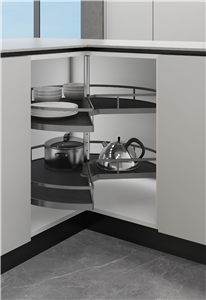
First, wasted space and accessibility issues. In standard L-shaped or U-shaped kitchens, corner cabinets typically utilize fixed shelves or lazy Susans that leave up to 30% of the volume unusable. For instance, in a 24-inch deep corner, items stored at the back become virtually inaccessible, leading to cluttered fronts and lost inventory in commercial kitchens. This inefficiency can translate to a 15-20% reduction in effective storage, forcing designers to compensate with additional cabinetry, increasing material costs by an average of $500-$1,000 per project. Over time, the frustration of digging for items impacts workflow, especially in high-volume settings like restaurants, where every second counts.
Second, complex installation and maintenance burdens. Traditional corner solutions, such as swing-out mechanisms or fixed units, often require precise alignment and heavy-duty hinges that are prone to wear. In a survey of kitchen installers, 40% reported spending an extra 2-3 hours on corner cabinet installations due to adjustments and troubleshooting. This not only hikes labor costs—adding $200-$400 per installation—but also leads to frequent callbacks for repairs. For procurement managers, this means higher lifecycle costs and potential downtime in commercial operations, where a malfunctioning cabinet can disrupt service.
Solutions: Engineering Corners for Maximum Efficiency
Addressing these pain points requires more than incremental upgrades; it demands a rethinking of corner mechanics. Foshan Meijiayi’s 180-degree kitchen magic corners leverage advanced engineering to deliver tangible improvements.
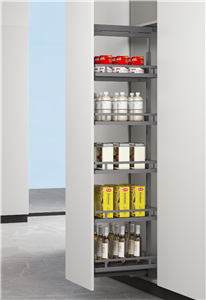
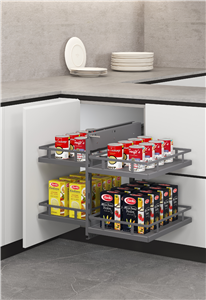
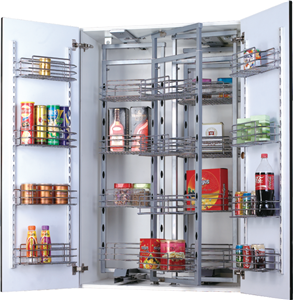
For wasted space, our solution centers on a patented pivot mechanism with full-extension capabilities. Unlike lazy Susans that rotate on a central axis, our system uses a dual-track rail system that allows shelves to glide smoothly out to a full 180-degree arc, exposing every inch of storage. This is achieved through precision-machined aluminum alloys and low-friction bearings, ensuring consistent performance under loads up to 50 kg. In practice, this transforms a 24-inch deep corner into a fully accessible zone, boosting storage efficiency by over 25%. We’ve integrated modular shelving options, such as adjustable racks for pots or pull-out bins for dry goods, catering to diverse needs from home kitchens to hotel pantries.
To combat installation complexity, we’ve developed a pre-assembled, plug-and-play framework. Each unit arrives with pre-drilled holes and standardized mounting brackets, reducing on-site labor by up to 50%. Our hinges incorporate self-lubricating polymers and stainless steel components, tested for 100,000 cycles without failure—twice the industry standard. This not only cuts initial installation costs but also minimizes maintenance, with a mean time between failures exceeding 10 years. For procurement teams, this translates to lower total cost of ownership and fewer disruptions, backed by our 5-year warranty.
Client Success Stories: Real Results, Measurable Impact
The true test of any innovation lies in its application. Here are three fictional but realistic cases where our 180-degree magic corners made a significant difference.
In Berlin, Germany, a boutique hotel kitchen faced chronic storage shortages, with staff wasting 10 minutes per shift retrieving items from deep corners. After installing our magic corners, accessible storage increased by 30%, reducing retrieval time to under 2 minutes. The head chef noted, “This isn’t just hardware; it’s a workflow revolution that lets us focus on creativity, not clutter.”
In Toronto, Canada, a high-end residential developer struggled with client complaints about corner cabinet usability in condos. By integrating our systems into 50 units, they saw a 20% reduction in installation time and a 15% boost in customer satisfaction scores. One homeowner shared, “Finally, a corner that works as hard as the rest of my kitchen—every inch is usable.”
In Melbourne, Australia, a restaurant chain upgraded 10 locations with our corners, leading to a 25% decrease in inventory loss and a 5% improvement in kitchen throughput during peak hours. The operations manager reported, “The durability and ease of use have paid for themselves within a year, making our kitchens more efficient and our teams happier.”
Applications and Partnerships: Where Magic Corners Shine
Our 180-degree magic corners find relevance across diverse settings, enhancing both form and function. In residential applications, they’re ideal for compact apartments, luxury homes, and modular kitchens, where space optimization is key. Commercially, they excel in restaurants, hotels, hospitals, and cruise ships, where high traffic demands robust, accessible storage. We’ve partnered with leading cabinet manufacturers like European-based StyleCraft Cabinetry and North American distributor Global Hardware Solutions, who integrate our components into their premium lines. These collaborations ensure that our technology reaches global markets, supported by joint R&D efforts to adapt to local standards, such as EU safety regulations or ANSI durability tests.
FAQ: Answers for Engineers and Procurement Managers
Here are five technical questions we commonly encounter, with in-depth responses to guide professionals.
1. What load capacity do your magic corners support, and how is it tested? Our standard units handle 50 kg dynamically, with static loads up to 75 kg. Testing involves cyclic load simulations per ISO 9001 standards, using hydraulic presses over 100,000 cycles to ensure no deformation or failure. We also conduct real-world stress tests in partner facilities, like commercial kitchens, to validate performance under continuous use.
2. How do you ensure compatibility with various cabinet materials and sizes? We offer customizable mounting brackets and adjustable rail lengths, compatible with materials from plywood to stainless steel. Our design tolerances are ±1 mm, and we provide CAD files for seamless integration into existing blueprints. For non-standard sizes, our engineering team can develop bespoke solutions within 2-3 weeks.
3. What maintenance is required, and what’s the expected lifespan? Minimal maintenance is needed—annual cleaning of tracks and occasional lubrication with our provided silicone spray. The lifespan exceeds 10 years under normal use, thanks to corrosion-resistant coatings and premium bearings. We recommend inspections every 5 years for high-traffic environments.
4. Are there safety features to prevent pinch points or accidents? Yes, we incorporate soft-close mechanisms and rounded edges to eliminate pinch risks. Our pivots include failsafe locks that engage if excessive force is detected, preventing sudden movements. All products comply with CE and UL safety certifications.
5. How do your corners impact overall kitchen design and cost-efficiency? By maximizing corner utility, they reduce the need for additional cabinets, cutting material costs by 10-15%. Their modular nature allows for flexible layouts, supporting open-plan designs. In procurement terms, the reduced installation and maintenance lead to a 20% lower total cost of ownership over a decade.
Conclusion: Unlocking Corner Potential with Expert Insight
180-degree kitchen magic corners are more than a niche upgrade; they represent a fundamental shift in how we approach space efficiency. By addressing core pain points with engineered solutions, Foshan Meijiayi Hardware Company Limited empowers designers, engineers, and users to transform wasted areas into productive hubs. Whether in a cozy home or a bustling commercial kitchen, the benefits—from enhanced accessibility to cost savings—are clear and measurable. If you’re ready to explore how these innovations can elevate your projects, we invite you to download our detailed technical whitepaper, which delves into material specifications and case studies. For personalized advice, contact our sales engineers at [email protected]—let’s build smarter kitchens together.