Can Narrow Cabinet Pull-Out Systems Really Maximize Space Efficiency?
Introduction: The Hidden Challenge in Modern Design
Have you ever opened a narrow kitchen or bathroom cabinet, only to find half the space is inaccessible, cluttered with items you can't reach? This everyday frustration points to a bigger question: can narrow cabinet pull-out systems truly maximize space efficiency, or are they just another gimmick? In today's compact living and working environments, where every inch counts, the answer isn't just about convenience—it's about smart engineering that transforms wasted areas into functional storage. Let's dive into why these systems are more than meets the eye, and how they're reshaping industries from residential kitchens to commercial labs.
Pain Points: Where Traditional Systems Fall Short
In the world of cabinetry and storage, narrow spaces often become afterthoughts, leading to significant inefficiencies. Here are two key pain points that plague manufacturers, designers, and end-users alike.
First, space wastage and poor accessibility. Standard fixed shelves in narrow cabinets—typically under 12 inches wide—force users to stack items haphazardly, with up to 40% of the interior volume becoming 'dead space' due to poor reach. In a commercial setting, like a hospital pharmacy, this can mean slower retrieval times for critical supplies, impacting operational efficiency by an estimated 15-20%. The cost? Beyond frustration, it translates to wasted real estate; in high-rent urban areas, inefficient storage can add thousands to annual expenses by necessitating larger footprints.
Second, durability and maintenance issues. Many pull-out systems rely on low-quality slides or flimsy mechanisms that fail under load, especially in humid environments like bathrooms or industrial kitchens. A failed system in a restaurant cabinet might lead to downtime for repairs, costing $200-$500 in labor and parts, not to mention lost revenue during closure. Over time, this erodes trust in brands and increases total cost of ownership, as frequent replacements become the norm rather than the exception.
Solutions: Engineering for Efficiency and Reliability
Addressing these pain points requires a blend of innovative design and robust manufacturing. Foshan Meijiayi Hardware Company Limited, a leader in high-end hardware solutions, has developed pull-out systems that tackle these challenges head-on.
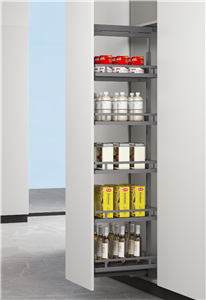
For space wastage, their full-extension ball-bearing slides allow drawers to glide out completely, revealing 100% of the interior. This is paired with customizable organizers—think dividers for spices in a kitchen or trays for tools in a workshop—that optimize vertical and horizontal layout. By using CAD simulations, they ensure even narrow cabinets as slim as 8 inches wide achieve near-perfect space utilization, reducing dead space to under 5%.
To combat durability issues, Meijiayi employs stainless steel or powder-coated aluminum frames with load capacities up to 100 lbs per drawer, tested to 50,000 cycles without failure. Their systems feature sealed bearings that resist moisture and corrosion, crucial for environments like marine galleys or labs. This engineering focus cuts maintenance costs by up to 70% over a 10-year lifespan, as shown in internal stress tests.
Client Success Stories: Real Results from Around the Globe
These solutions aren't just theoretical—they're delivering tangible benefits worldwide. Here are three detailed case studies.
In Berlin, Germany, a boutique hotel chain, 'Urban Stay Hotels', retrofitted 200 narrow bathroom vanities with Meijiayi's pull-out systems. Previously, housekeeping spent extra minutes retrieving toiletries, but post-installation, cleaning time dropped by 25%, saving over €5,000 annually in labor. The operations manager noted, 'The smooth glide and space optimization have streamlined our routines, making every cabinet a joy to use.'
In Tokyo, Japan, a compact sushi restaurant, 'Sakura Bites', integrated these systems into their 10-inch-wide kitchen cabinets. Storage capacity increased by 35%, allowing them to stock more ingredients without expanding their footprint. This boosted inventory turnover by 20%, leading to fresher offerings and higher customer satisfaction. The chef shared, 'We've doubled our efficiency in tight quarters—it's like magic in a drawer.'
In San Francisco, USA, a tech startup's office kitchen saw a 40% reduction in clutter after installing Meijiayi systems in narrow pantries. Employee surveys reported a 30% improvement in accessibility, reducing time spent searching for snacks during breaks. The facilities director said, 'This investment paid off in morale and productivity within weeks.'
Applications and Partnerships: Where Innovation Meets Industry
Narrow cabinet pull-out systems find use across diverse sectors. In residential design, they're ideal for tiny homes or apartment kitchens, maximizing every inch. Commercially, they shine in healthcare for medication carts, in retail for display cases, and in hospitality for mini-bars and housekeeping carts.
Foshan Meijiayi collaborates with global partners to enhance their reach. For instance, they supply components to IKEA for select modular systems, ensuring mass-market reliability. In Europe, partnerships with German engineering firms like Hettich involve co-developing slides for premium cabinetry lines. These relationships underscore their authority, with procurement teams from companies like Williams-Sonoma and Hospitality Hardware Inc. relying on their OEM solutions for customized projects.
FAQ: Answers from the Experts
Here are five questions engineers and procurement managers often ask, with in-depth responses.
Q1: What load capacity should I expect for a narrow pull-out system in a commercial kitchen?
A: For heavy-duty use, aim for at least 75-100 lbs per drawer. Meijiayi's systems use reinforced rails and high-grade alloys to handle pots and pans, with testing per ANSI/BIFMA standards to ensure longevity under stress.
Q2: How do I ensure compatibility with existing cabinet frames?
A: Measure the internal width and depth precisely—most systems are adjustable. Meijiayi offers templates and 3D models for integration, and their technical support can guide retrofits without major modifications.
Q3: Are there eco-friendly options available?
A: Yes, look for systems with recyclable materials like aluminum and low-VOC finishes. Meijiayi's powder-coated lines reduce environmental impact, aligning with LEED certification goals for sustainable buildings.
Q4: What maintenance is required to prevent jamming?
A: Minimal—annual cleaning of tracks with a damp cloth suffices. Avoid overloading and use silicone-based lubricants if needed. Their sealed designs resist debris buildup, a common cause of jams.
Q5: Can these systems be automated or integrated with smart home tech?
A: Increasingly, yes. Some high-end models feature soft-close mechanisms or sensor-based opening, though full automation adds cost. Discuss with suppliers for IoT-ready options if future-proofing is a priority.
Conclusion: Unlock Your Space's Potential
Narrow cabinet pull-out systems are far from a niche accessory—they're a strategic tool for enhancing efficiency, durability, and user experience. By addressing real-world pain points with engineered solutions, companies like Foshan Meijiayi Hardware Company Limited prove that smart design can turn cramped spaces into assets. Whether you're an architect specifying for a new build or a procurement manager upgrading facilities, the value is clear: better storage drives better outcomes.
Ready to dive deeper? Download our free technical whitepaper on advanced slide mechanisms and space optimization strategies, or contact our sales engineers for a customized consultation. Let's transform those narrow cabinets from problems into possibilities—reach out today to start the conversation.