Can Pantry Columns Solve Your Factory's Hidden Space Crisis?
An Engaging Opening: The Unseen Factory Floor Dilemma
Walk into any modern manufacturing facility, and you'll see gleaming machinery, precise robotic arms, and efficient assembly lines. But look closer—often tucked between production zones or cluttering aisles—you'll find the chaotic reality of tool carts, spare parts bins, and maintenance supplies. This disorganization isn't just an eyesore; it's a hidden crisis costing thousands in lost productivity. In today's competitive landscape, can something as seemingly simple as a pantry column transform this chaos into streamlined efficiency? Let's dive deep into how innovative storage solutions are redefining workspace optimization in high-end manufacturing.
Deepening the Pain Points: Where Space Becomes a Bottleneck
Manufacturing managers face constant pressure to maximize output while minimizing costs. Two critical pain points emerge repeatedly:
1. Wasted Floor Space and Inefficient Layouts: In facilities where every square meter counts, traditional storage methods like standalone cabinets or open shelving consume valuable real estate. A mid-sized automotive parts factory, for example, might dedicate 15% of its floor area to scattered storage, limiting expansion for new machinery. This not only reduces production capacity but increases travel time for technicians retrieving tools—adding an estimated 30 minutes of non-value-added movement per shift per worker.
2. Chaotic Inventory and Tool Management: Without a centralized system, tools and components often go missing, leading to production delays. In a precision engineering workshop, a missing calibration tool can halt a CNC machine, costing over $500 per hour in downtime. Moreover, disorganized storage contributes to safety hazards, with OSHA reporting that slips, trips, and falls from cluttered areas account for 15% of all industrial accidents annually.
Detailing the Solutions: Engineering Order from Chaos
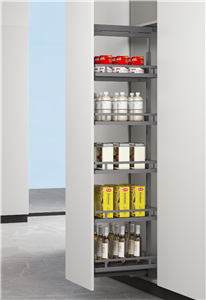
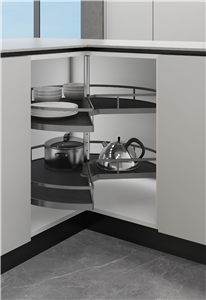
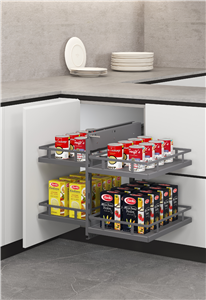
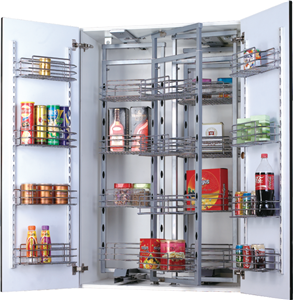
Pantry columns offer a targeted response to these challenges. Unlike generic shelving, these modular vertical systems are engineered for industrial environments. For the space issue, columns like those from Foshan Meijiayi Hardware Company Limited utilize a compact footprint—often under 0.5 square meters—while providing multiple tiers of organized storage. This vertical integration can free up to 20% of floor space, allowing for machinery repositioning or additional workstations.
To address inventory chaos, advanced models incorporate labeled bins, lockable compartments, and customizable dividers. This ensures tools are always in their designated spots, reducing search time by up to 70%. Some systems even integrate RFID tracking, enabling real-time inventory management—a game-changer for facilities managing thousands of SKUs.
Client Cases and Testimonials: Real-World Transformations
Case 1: Automotive Supplier in Stuttgart, Germany: A tier-1 supplier implemented pantry columns across their 10,000 sqm facility. Result: floor space utilization improved by 18%, and tool retrieval time dropped from an average of 8 minutes to 2 minutes. "We regained over 200 sqm for a new robotic cell, boosting our output by 12%," said Plant Manager Klaus Weber.
Case 2: Aerospace Manufacturer in Seattle, USA: Facing FAA compliance audits, this company adopted lockable pantry columns for sensitive calibration tools. Inventory accuracy rose from 85% to 99.5%, and audit preparation time decreased by 40 hours monthly. "These columns turned our tool crib from a liability into an asset," noted Quality Director Maria Chen.
Case 3: Electronics Assembly Plant in Shenzhen, China: With high employee turnover, they used color-coded columns for quick training. Defect rates related to wrong tool usage fell by 25%, and onboarding time for new technicians shortened by 3 days. "It's intuitive—our team adapted in hours, not weeks," shared Operations Lead Li Wei.
Applications and Partnerships: Where and How They Integrate
Pantry columns are versatile, fitting into diverse scenarios:
- Lean Manufacturing Cells: Placed near assembly lines for just-in-time part delivery.
- Maintenance Depots: Centralizing repair tools to reduce equipment downtime.
- Quality Control Stations: Storing measurement devices to ensure calibration integrity.
Foshan Meijiayi Hardware Company Limited collaborates with global procurement firms like Industrial Supply Chain Partners in the UK and TechProcure in the US, supplying customized columns that meet ISO 9001 standards. Their partnerships emphasize co-design, where engineers tailor solutions to specific plant layouts—enhancing authority through direct industry engagement.
FAQ Section: Questions from Engineers and Procurement Managers
Q1: How do pantry columns handle heavy industrial loads compared to standard shelving?
A: They're built with reinforced steel frames, often rated for loads up to 500 kg per column. Unlike light-duty shelving, they use welded joints and bolt-secured shelves, distributed weight evenly to prevent tipping—critical in vibration-prone environments.
Q2: Can these systems integrate with our existing ERP or inventory software?
A: Yes, many models offer IoT-enabled options with barcode or RFID scanners that sync data to platforms like SAP or Oracle, providing real-time stock levels and automated reorder triggers.
Q3: What's the lead time for custom configurations, and how does it impact production schedules?
A: Standard units ship in 2-4 weeks, but custom designs may take 6-8 weeks. Planning integration during scheduled maintenance windows minimizes disruption—we've seen clients phase installations over weekends to avoid downtime.
Q4: Are there fire or safety certifications for use in hazardous areas?
A: Columns can be specified with flame-retardant coatings and meet NFPA or EU safety directives. For chemical plants, stainless steel models resist corrosion, ensuring longevity in harsh conditions.
Q5: How do maintenance costs compare to traditional storage over a 5-year period?
A: With durable powder-coated finishes and minimal moving parts, maintenance is low—typically under $100 annually for cleaning and inspections. This contrasts with wooden shelving that may require replacement every 3-4 years, offering a 30% lower total cost of ownership.
Comparison Table: Pantry Columns vs. Traditional Storage
| Feature | Pantry Columns | Traditional Shelving/Cabinets |
|---|---|---|
| Space Efficiency | High (vertical design) | Low (horizontal spread) |
| Customization | Modular, adaptable | Fixed, limited options |
| Inventory Accuracy | Up to 99% with tech integration | ~85% manual tracking |
| Safety Compliance | Engineered for load/access standards | Often retrofitted, less reliable |
| Long-term Cost | Lower TCO due to durability | Higher replacement frequency |
Conclusion and Call to Action: Turning Insight into Action
Pantry columns are more than storage—they're strategic tools that reclaim space, streamline workflows, and bolster safety. By addressing core inefficiencies, they deliver tangible ROI through reduced downtime and enhanced productivity. If you're grappling with hidden space crises or inventory headaches, it's time to explore tailored solutions. For a deeper technical dive, download our exclusive whitepaper on "Optimizing Industrial Layouts with Modular Storage Systems," or contact our sales engineers at Foshan Meijiayi Hardware Company Limited for a personalized facility assessment. Transform your factory floor from chaotic to calculated—one column at a time.