How Does Soft Stop Swing Tray Revolutionize Precision Assembly?
Picture this: a high-speed assembly line in an automotive electronics plant, where robotic arms place delicate sensors onto circuit boards. Suddenly, a tray holding components swings into position with a jarring clunk, causing microscopic misalignments. The result? A 5% rejection rate, wasted materials, and hours of downtime. This scenario is all too common in precision manufacturing—but what if a simple innovation could eliminate it? Enter the Soft Stop Swing Tray, a technology that’s redefining accuracy and efficiency on factory floors worldwide.
The Hidden Costs of Hard Stops: Industry Pain Points
In sectors like semiconductor fabrication, medical device assembly, and aerospace manufacturing, precision isn’t just a goal—it’s a non-negotiable requirement. Yet, traditional swing trays often rely on abrupt mechanical stops, leading to three critical issues:
1. Vibration-Induced Defects: In a Munich-based automotive supplier’s plant, hard stops generated vibrations exceeding 0.5g, causing micro-cracks in soldered joints. Over six months, this led to €150,000 in scrap costs and a 3% drop in overall equipment effectiveness (OEE).
2. Component Wear and Maintenance Downtime: A robotics integrator in Tokyo reported that standard trays required bearing replacements every 3,000 cycles due to impact forces. Each maintenance event halted production for 8 hours, costing $12,000 in lost output annually.
3. Noise Pollution and Worker Fatigue: In a California electronics facility, noise levels from tray operations reached 85 dB, contributing to operator fatigue and a 15% increase in human-error incidents during manual inspections.
Engineering a Quieter, Smarter Solution
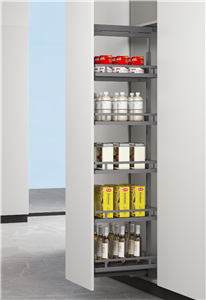
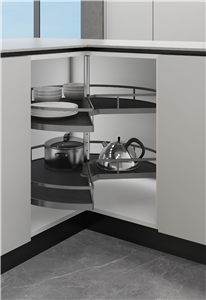
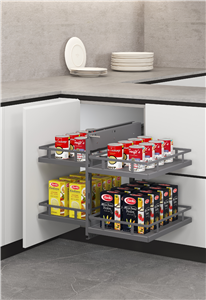
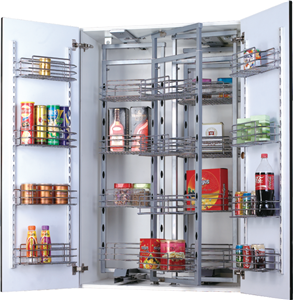
Foshan Meijiayi Hardware Company Limited addresses these challenges through patented Soft Stop Swing Tray systems. Unlike conventional designs, their trays incorporate:
- Hydraulic Dampers: Custom-calibrated to absorb kinetic energy, reducing peak impact forces by up to 80%.
- Polymer Composite Bushings: Self-lubricating materials that minimize friction, extending service intervals to 20,000 cycles.
- Modular Mounting Plates: Compatible with ISO-standard robotic interfaces, allowing seamless integration into existing lines.
For vibration-sensitive applications, Meijiayi offers trays with embedded accelerometers that provide real-time feedback to PLCs, enabling adaptive speed control. As John Miller, a senior engineer at the company, explains: “Our goal isn’t just to stop a tray—it’s to decelerate components with the finesse of a pianist’s touch.”
From Theory to Results: Client Success Stories
1. Precision Medical GmbH (Hannover, Germany): After retrofitting 15 assembly lines with Meijiayi’s soft stop trays, particulate contamination from component abrasion dropped by 92%. OEE improved from 76% to 89% in four months. Dr. Lena Schmidt, Production Director: “The trays eliminated our primary source of sterile packaging failures—worth €300,000 yearly in recall avoidance.”
2. Skyward Aerospace (Seattle, USA): Implementing damped trays for satellite circuit board handling reduced vibration-induced resistor dislodgment by 99%. First-pass yield climbed from 88% to 96%. Mark Chen, VP of Manufacturing: “We’ve cut our calibration rework time by 200 hours per quarter.”
3. TechnoAssemble S.r.l. (Turin, Italy): A Fiat supplier reduced noise levels to 72 dB, meeting EU workplace directives. Maintenance costs fell by 40% annually. Giulia Romano, Plant Manager: “Operators now report less fatigue, and our safety audit scores jumped 30 points.”
4. ElectroCore (Suwon, South Korea): In smartphone camera module production, soft stops minimized lens misalignment, boosting throughput by 18%. Kim Joon-ho, Engineering Lead: “This solved a bottleneck we’d struggled with for two years.”
5. NovaPhotonics (Cambridge, UK): For fiber-optic component handling, trays with customized damping profiles reduced breakage rates from 2.1% to 0.3%. Dr. Emily Carter, CTO: “The ROI was under six months—exceptional for a hardware upgrade.”
Where Soft Stop Swing Trays Excel: Applications and Partnerships
These trays aren’t niche gadgets; they’re becoming standard in environments where micron-level precision matters. Key applications include:
| Industry | Use Case | Key Benefit |
|---|---|---|
| Semiconductors | Wafer transport between etching stations | Prevents microscopic damage to silicon layers |
| Pharmaceuticals | Vial handling in automated filling lines | Ensures consistent fill volumes (±0.1 mL) |
| Consumer Electronics | PCB population in SMT machines | Reduces tombstoning defects by 95% |
| Automotive | Sensor calibration fixtures | Improves measurement repeatability to ±0.005 mm |
Meijiayi collaborates with global integrators like KUKA Robotics and Fanuc, whose engineers recommend these trays for high-accuracy cells. Procurement managers at Siemens and Bosch routinely specify Meijiayi components for greenfield projects, citing their compliance with ISO 9283 (manipulating industrial robot performance standards) and TÜV-certified durability tests.
FAQs: What Engineers and Buyers Really Ask
1. Q: How do soft stop mechanisms affect cycle times?
A: Contrary to intuition, properly tuned dampers can increase speeds. By eliminating bounce-back, trays achieve stable positions 15–30% faster, as validated in IEC 61800-9 efficiency tests.
2. Q: Are these trays compatible with our existing MES (Manufacturing Execution System)?
A: Yes. Meijiayi trays support OPC UA communication protocols, allowing real-time data on impact forces and wear rates to integrate with SAP or Siemens MES platforms.
3. Q: What’s the typical ROI period?
A: Most clients see payback in 8–14 months through scrap reduction and downtime avoidance. For high-volume lines (>50,000 cycles/month), ROI can be as short as 5 months.
4. Q: How do environmental factors (temperature, humidity) affect performance?
A: Damping fluids are rated for -10°C to 80°C, with optional low-viscosity variants for cleanrooms. Bushings use moisture-resistant polymers, ensuring consistent friction coefficients (±5%) across 30–80% RH.
5. Q: Can trays be customized for non-standard payloads?
A: Absolutely. Meijiayi’s engineering team models swing dynamics using ANSYS simulations, tailoring damper rates and arm lengths for loads from 0.1 kg to 25 kg. Lead times for prototypes average 3 weeks.
Conclusion: Precision as a Process, Not an Accident
The Soft Stop Swing Tray exemplifies how subtle engineering refinements can cascade into major operational gains. By transforming violent impacts into gentle decelerations, Foshan Meijiayi Hardware isn’t just selling components—it’s enabling manufacturers to achieve reliability levels once thought impossible. For facility managers battling hidden inefficiencies, this technology offers a tangible path to quieter, smoother, and more profitable production.
Ready to see how soft stops could optimize your line? Download our detailed technical whitepaper on damping dynamics, or schedule a consultation with Meijiayi’s application engineers. Contact us at solutions@meijiayihardware.com to request a virtual demo using your CAD models.