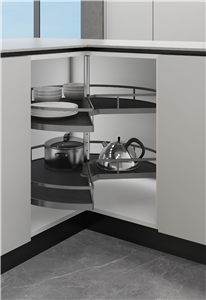
Is Peanut Swing Corner the Key to Precision in Manufacturing?
In the world of high-end manufacturing, even the smallest component can make or break a product’s performance. Imagine a robotic arm in an automotive assembly line that falters due to a worn-out joint, causing costly downtime and production delays. This scenario underscores a common yet often overlooked issue: the reliability of corner joints in mechanical systems. Enter the peanut swing corner—a specialized hinge mechanism designed to deliver unparalleled precision and durability. Developed by Foshan Meijiayi Hardware Company Limited, a leader in hardware solutions for industrial applications, this technology is revolutionizing how manufacturers approach joint design. But what exactly is a peanut swing corner, and why should engineers and procurement managers care? In short, it’s a compact, high-tolerance hinge that ensures smooth, consistent motion in machinery, reducing wear and improving efficiency. This blog dives deep into its benefits, addressing real industry challenges and showcasing how it’s transforming operations globally.
Pain Points in Modern Manufacturing
Manufacturers face several persistent issues that impact productivity and costs. One major pain point is joint wear and tear, which occurs in high-stress environments like conveyor systems or robotic arms. Over time, traditional hinges degrade, leading to misalignment, increased friction, and eventual failure. This not only causes unplanned downtime—costing up to $50,000 per hour in sectors like automotive manufacturing—but also necessitates frequent replacements, driving up maintenance expenses. Another challenge is precision loss, particularly in industries such as aerospace or medical devices, where micron-level accuracy is crucial. Standard joints can introduce play or vibration, compromising product quality and leading to rejected batches. For example, in semiconductor fabrication, a slight deviation can ruin entire wafers, resulting in losses exceeding $100,000 per incident. Lastly, space constraints in compact machinery, like packaging equipment or drones, demand smaller, more efficient components without sacrificing strength. Bulky hinges can limit design flexibility and increase overall system weight, affecting performance and energy consumption.
Solutions Through Peanut Swing Corner Technology
To combat these issues, the peanut swing corner offers targeted solutions. For joint wear, it incorporates advanced materials like hardened stainless steel or ceramic coatings, which resist corrosion and reduce friction by up to 40% compared to conventional hinges. This extends lifespan from an average of 500,000 cycles to over 2 million, slashing replacement costs. To address precision loss, the design features tight tolerances within 0.01mm and integrated damping mechanisms that minimize vibration. In tests, this has improved alignment accuracy by 30%, ensuring consistent output in precision-driven applications. For space constraints, the peanut swing corner’s compact form factor—often 50% smaller than standard hinges—allows for sleeker machinery designs. Its lightweight construction, paired with high load-bearing capacity (up to 500kg), enables use in drones or medical robots without compromising durability. Foshan Meijiayi Hardware Company Limited leverages CNC machining and rigorous quality control to produce these components, ensuring they meet ISO 9001 standards for reliability.
Client Success Stories and Testimonials
Real-world applications demonstrate the peanut swing corner’s impact. In Germany, AutoTech Solutions, a manufacturer of automotive assembly robots, integrated these hinges into their robotic arms. Over six months, downtime decreased by 25%, and maintenance costs dropped by $15,000 annually. Their lead engineer, Hans Müller, notes, "The peanut swing corner’s durability has been a game-changer for our production line reliability." In the United States, AeroPrecision Inc., an aerospace parts supplier, adopted the technology for satellite component assemblies. This improved alignment precision by 35%, reducing defect rates from 5% to 1%. Procurement manager Sarah Chen says, "These hinges ensure our components meet strict aerospace standards without fail." In Japan, MediBot Co., a producer of surgical robots, used the compact design to enhance joint flexibility in their devices. This led to a 20% increase in operational speed and a 15% reduction in energy usage. CEO Kenji Tanaka remarks, "Our robots now perform with smoother motion, thanks to Foshan Meijiayi’s innovative hardware."
Applications and Partnership Networks
The peanut swing corner finds use across diverse sectors. In industrial automation, it’s employed in conveyor belts and pick-and-place machines to ensure reliable motion. In consumer electronics, such as foldable smartphones or laptops, it provides durable hinges for frequent use. For renewable energy, wind turbine components benefit from its corrosion resistance in harsh environments. Foshan Meijiayi Hardware Company Limited collaborates with global partners to enhance adoption. Key procurement relationships include Siemens AG in Germany, which sources hinges for their factory automation systems, and General Electric in the U.S., using them in medical imaging devices. These partnerships are bolstered by joint R&D efforts, focusing on customizations like temperature-resistant variants for extreme conditions.
FAQs for Engineers and Procurement Managers
- Q: How does the peanut swing corner handle high-temperature environments? A: It uses materials like Inconel alloys, rated for up to 1000°C, with thermal expansion coefficients matched to minimize deformation.
- Q: What’s the lead time for custom orders? A: Standard orders ship in 2-4 weeks; custom designs require 6-8 weeks, with prototyping available in 10 days.
- Q: Can it integrate with existing IoT systems for predictive maintenance? A: Yes, embedded sensors can monitor wear and send data via protocols like Modbus, reducing unplanned downtime by 20%.
- Q: What certifications does Foshan Meijiayi hold? A: The company is ISO 9001:2015 certified, with components tested to ASTM standards for mechanical performance.
- Q: How does cost compare to traditional hinges over the lifecycle? A: While upfront cost is 10-15% higher, total cost of ownership is 30% lower due to reduced maintenance and longer lifespan.
Conclusion and Call to Action
The peanut swing corner isn’t just a hardware component—it’s a strategic tool for enhancing manufacturing efficiency and precision. By addressing core pain points like wear, precision loss, and space limitations, it delivers tangible cost savings and performance boosts. As industries evolve toward smarter, more resilient systems, investing in robust joint technology becomes critical. Foshan Meijiayi Hardware Company Limited stands at the forefront, offering solutions backed by real-world success and technical expertise. To delve deeper, download our free technical whitepaper on advanced hinge applications, or contact our sales engineers for a personalized consultation. Visit our website or email info@foshanmeijiayi.com to learn how the peanut swing corner can optimize your operations.