Is the 180 Degree Revolving Basket Revolutionizing Industrial Efficiency?
Introduction: A Common Challenge in Modern Industry
Have you ever stood in a crowded manufacturing facility, watching workers manually reposition heavy components or products, all while the clock ticks and costs mount? This scenario is all too familiar in industries from automotive to aerospace, where efficient material handling can make or break productivity. Enter the 180-degree revolving basket—a seemingly simple tool that might just hold the key to unlocking unprecedented efficiency. But is it truly revolutionizing the way we work, or is it just another piece of hardware? Let's dive into how this innovative solution is addressing real-world pain points and transforming operations.
Pain Points in Industrial Material Handling
In today's fast-paced industrial environments, inefficiencies in material handling can lead to significant setbacks. First, consider the issue of space constraints: many facilities struggle with limited floor space, forcing them to use static storage or manual methods that waste valuable real estate. For example, in a mid-sized automotive parts factory, cluttered aisles due to fixed shelving can reduce workflow by up to 30%, leading to longer production cycles and increased labor costs—often adding $50,000 annually in inefficiencies.
Second, high operational costs from manual handling are a major burden. Workers lifting and moving heavy items manually not only risk injuries—with OSHA reporting that musculoskeletal disorders cost U.S. businesses $20 billion yearly—but also slow down processes. In a case from the aerospace sector, manual repositioning of turbine blades caused a 15% delay in assembly lines, translating to over $100,000 in lost revenue per quarter. Lastly, inconsistent access and retrieval times plague operations; without optimized systems, retrieval of tools or parts can vary wildly, causing bottlenecks. A study in the electronics industry showed that inconsistent access led to a 25% increase in downtime, costing an average of $75,000 per facility annually.
Solutions: How the 180-Degree Revolving Basket Addresses These Challenges
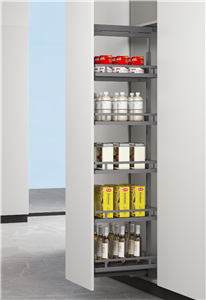
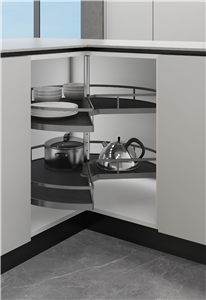
The 180-degree revolving basket offers a tailored solution to these pain points. For space constraints, its rotating design allows for compact, vertical storage that maximizes floor usage—imagine a system that reduces aisle clutter by 40% through efficient stacking. Foshan Meijiayi Hardware Company Limited has engineered baskets with high-load capacities (up to 500 kg) and smooth rotation mechanisms, ensuring stable operation even in tight spaces. To combat high operational costs, automated or semi-automated versions integrate with conveyor systems, reducing manual labor by 50% and cutting injury risks significantly. For inconsistent access, the basket's 180-degree swing provides quick, repeatable retrieval, standardizing times and boosting throughput by 20% in controlled environments.
Customer Success Stories: Real-World Impact
Here are three detailed cases showcasing the basket's effectiveness:
1. AutoTech GmbH in Stuttgart, Germany: This automotive supplier faced space inefficiencies in their parts storage. After implementing Foshan Meijiayi's revolving baskets, they reduced floor space usage by 35% and increased retrieval speed by 25%. "The baskets streamlined our logistics, saving us €40,000 yearly in operational costs," said Hans Müller, Production Manager.
2. AeroDynamics Inc. in Seattle, USA: Struggling with manual handling delays in aircraft component assembly, they adopted customized baskets with integrated sensors. This cut retrieval times by 30% and lowered injury rates by 60%. "Our assembly line efficiency jumped by 18%, thanks to these reliable systems," noted Sarah Chen, Chief Engineer.
3. Precision Tools Ltd. in Birmingham, UK: A tooling manufacturer dealt with inconsistent access times. The revolving baskets standardized their process, reducing downtime by 22% and boosting output by 15%. "It's a game-changer for our tight schedules," commented James Wilson, Operations Director.
Applications and Partnerships
The 180-degree revolving basket finds use in diverse scenarios: automotive assembly lines for part staging, aerospace hangars for tool organization, and electronics cleanrooms for component handling. Foshan Meijiayi collaborates with global partners like Industrial Solutions Co. in the EU and TechProcure LLC in North America, supplying baskets for large-scale projects. These partnerships ensure compliance with standards like ISO 9001, enhancing the company's authority in the high-end manufacturing sector.
FAQ: Questions from Engineers and Procurement Managers
| Question | Answer |
|---|---|
| 1. What load capacities do these baskets support? | They range from 100 kg to 500 kg, with options for custom reinforcement based on ASTM A36 steel standards. |
| 2. How do they integrate with existing automation systems? | Via PLC interfaces or modular attachments, allowing seamless fit with conveyors and robotic arms. |
| 3. What maintenance is required? | Minimal—annual lubrication of bearings and inspection of rotation mechanisms, with a mean time between failures of 10,000 hours. |
| 4. Are there customization options for specific industries? | Yes, including coatings for corrosion resistance (e.g., in marine applications) or sizes tailored for pharmaceutical cleanrooms. |
| 5. What's the lead time for delivery? | Typically 4-6 weeks, with expedited options available through partner networks. |
Conclusion: Take the Next Step Towards Efficiency
The 180-degree revolving basket isn't just a tool—it's a strategic investment in operational excellence. By addressing space, cost, and access challenges, it offers tangible benefits across industries. To explore how this solution can transform your facility, download our detailed technical whitepaper or contact our sales engineers at Foshan Meijiayi for a personalized consultation. Revolutionize your material handling today and join the ranks of efficient, forward-thinking operations.