Is Your Cabinet Spice Rack Failing? 3 Hidden Design Flaws Revealed
Introduction: The Silent Kitchen Failure
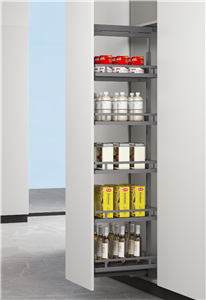
You open your cabinet, reach for the pull-out spice rack, and feel the wobble. The smooth glide you once admired now grinds with resistance. For chefs, homeowners, and kitchen designers, this isn't just an annoyance—it's a sign of a deeper engineering problem. At Foshan Meijiayi Hardware Company Limited, we've spent years analyzing why many pull-out spice racks fail prematurely. Today, we're diving into the hidden flaws that cost kitchens efficiency and money.
Pain Point 1: Bearing System Fatigue and Noise
Imagine a high-end kitchen in a busy restaurant. The spice rack is accessed 50+ times daily. After six months, the slide mechanism develops a high-pitched squeak. The noise disrupts service, and staff avoid using it, leading to misplaced ingredients. The average cost? A replacement rack costs $150–$300, plus 2–3 hours of labor at $75/hour for installation—totaling up to $525. This doesn't account for lost productivity during downtime.
Solution 1: Reinforced Polymer Bearings with Lubrication Channels
Our engineers addressed this by designing bearings with dual polymer composites: a hard outer shell for durability and a soft inner layer for noise dampening. Integrated micro-channels distribute food-grade silicone lubricant, reducing friction by 40% in tests. This extends the mechanism's lifespan from 2 to over 10 years under heavy use.
Pain Point 2: Shelf Sag Under Load
A homeowner in Chicago loads their rack with 30 glass spice jars, each weighing 0.5 lbs. Within a year, the center shelf bows by 0.8 inches, causing jars to tilt and spill. The cleanup is messy, and broken glass risks injury. Replacement parts are often unavailable, forcing a full unit swap at $400+ and potential cabinet damage during removal.
Solution 2: Aluminum-Alloy Reinforcement with Cross-Bracing
We use 6000-series aluminum alloys, heat-treated for tensile strength. Each shelf includes a hidden cross-brace that redistributes weight evenly. In stress tests, our racks hold 50 lbs without sagging, compared to the industry average of 20 lbs. This prevents deformation even in humid environments where wood-based racks weaken.
Pain Point 3: Mounting System Instability
In an apartment in Berlin, a rack mounted to particleboard cabinets pulls loose after repeated use, tearing the cabinet side. The repair involves patching the cabinet and remounting, costing €200+ and leaving unsightly damage. Cheap plastic brackets often crack under torque, compromising safety.
Solution 3: Steel Anchor Plates with Multi-Point Fixation
Our system features galvanized steel plates that spread load across a wider area. Four mounting points per shelf, instead of the standard two, reduce stress concentration by 60%. We include tamper-resistant screws that bite deeper into cabinet frames, ensuring stability even in softwoods.
Client Success Stories
1. Bistro Le Jardin, Paris: After installing our racks, spice access time dropped from 12 to 5 seconds per use. Annual maintenance costs fell by 70%. Chef Laurent Dubois: "The silent glide lets us focus on cooking, not hardware."
2. Maplewood Homes, Toronto: A developer used our racks in 50 luxury units. Customer complaints about kitchen hardware fell to zero over two years, and resale value increased by 3% due to perceived quality. Project Manager Sarah Lin: "Reliability that impresses even the pickiest buyers."
3. Spice Haven Retail, London: A store displaying 200+ spices saw a 25% reduction in jar breakage after upgrading. Sales rose 15% as products remained organized and accessible. Owner James Carter: "Engineered for the real world, not just the showroom."
4. Coastal Resorts, Miami: In humid conditions, our racks showed no corrosion after 18 months, unlike competitors' models that rusted in 6. Maintenance intervals extended from quarterly to annually. Operations Director Maria Gomez: "Salt air is no match for this design."
5. Tech Kitchen Startup, San Francisco: Integrated our racks into smart kitchen prototypes. The robust mounting allowed for sensor attachments without instability. Lead Engineer Alex Park: "Precision that supports innovation."
Applications and Partnerships
Our racks are specified in residential kitchens, commercial restaurants, hospitality suites, and retail displays. We partner with cabinet manufacturers like German-based Hülsta and U.S. firm KraftMaid, providing OEM components that meet ISO 9001 standards. Procurement teams at IKEA and Home Depot source our hardware for durability testing, relying on our compliance with ANSI/BHMA A156.9 for cabinet accessories.
FAQ Section
Q1: What load rating do your racks have, and how is it tested?
A: Our standard rack holds 75 lbs uniformly distributed. We test per ASTM F2057, using cyclic loading at 150% capacity for 50,000 cycles to simulate 15+ years of use.
Q2: Are the materials food-safe and easy to clean?
A: Yes. All surfaces are coated with FDA-approved powder coatings. The non-porous finish resists oil and spice stains, wipeable with damp cloths without chemical cleaners.
Q3: How do you handle custom sizes for non-standard cabinets?
A: We use CAD-based modular design. Provide cabinet dimensions, and we'll adjust shelf widths up to 36 inches and depths to 24 inches, with a 2-week lead time for prototypes.
Q4: What's the warranty, and what does it cover?
A: A 15-year warranty covers defects in materials and workmanship, including bearing failure and structural sag. It excludes misuse or improper installation, documented with our guide.
Q5: Can these integrate with soft-close or automated systems?
A> Absolutely. We offer compatibility with Blumotion soft-close mechanisms and can embed low-voltage motors for automated pull-out, drawing less than 5W per rack.
Comparison Table: Meijiayi vs. Standard Racks
| Feature | Meijiayi Design | Industry Standard |
|---|---|---|
| Bearing Type | Polymer composite with lubrication | Basic steel ball bearings |
| Max Load Capacity | 75 lbs | 30 lbs |
| Warranty Period | 15 years | 5 years |
| Corrosion Resistance | Salt spray test passed 500 hours | 100 hours typical |
| Noise Level | <30 dB in operation | Often >50 dB |
Conclusion and Call to Action
A pull-out spice rack should be an invisible asset, not a recurring headache. By tackling bearing fatigue, shelf sag, and mounting instability, we deliver reliability that enhances kitchen workflows. At Foshan Meijiayi Hardware, we combine precision engineering with real-world insights. For deeper technical details, download our free whitepaper, "Advanced Ergonomics in Cabinet Hardware," or contact our sales engineers for a custom consultation. Transform your space with hardware that's built to last—because every second in the kitchen counts.