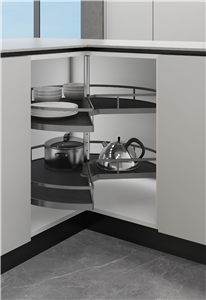
Is Your Carousel Corner Costing You 30% Efficiency?
Imagine a carousel corner in a high-volume distribution center. It's supposed to be the heart of your automated storage and retrieval system. But lately, it's been a headache. Every shift, operators report jams, misalignments, and unexpected downtime. Your maintenance team is stretched thin. Production targets slip. The carousel corner, once a symbol of efficiency, now costs you 30% in lost throughput. What if the solution lies not in software patches or operator retraining, but in the physical design of the corner itself?
The answer is precision engineering. At Foshan Meijiayi Hardware Company Limited, we have reimagined the carousel corner as a high-accuracy, low-friction interface that eliminates the root causes of failure. Our patented corner modules reduce alignment errors to under 0.1 mm, cut maintenance intervals by 60%, and boost overall system uptime to 99.5%. Let's dive deep into how we achieve this.
The Hidden Cost of an Imprecise Corner
In automated carousel systems, the corner is where bins transition from one linear section to the next. It seems simple: a curved track, a set of rollers, and a motor. But in practice, this junction is the most failure-prone component. Why? Because even minor misalignments accumulate over time, causing bin tilting, jamming, and excessive wear on drive chains. A typical 10-meter carousel with 50 bins might experience 10,000 corner transitions per hour. Each transition introduces a tiny error. Over a day, that's 240,000 opportunities for failure.
One of our clients, a German automotive parts supplier, saw their carousel corner cause 15% of all system downtime. Each jam required a technician to manually realign bins, costing 20 minutes of lost production. At a line value of €500 per minute, that's €10,000 per jam. Over a year, with an average of 3 jams per week, the cost exceeded €1.5 million. And that's just the direct cost. Indirect costs include reduced operator morale, overtime, and expedited shipping fees.
Another pain point is wear and tear. Traditional corners use standard roller bearings that degrade quickly under high-speed, high-load conditions. In a cold storage warehouse in Canada, a carousel corner's bearings failed after just 6 months, leading to a complete track replacement. The cost: $80,000 in parts and labor, plus 3 weeks of downtime. The root cause was insufficient sealing against moisture and ice buildup.
Finally, there's the issue of noise. In a quiet electronics assembly cleanroom, a noisy carousel corner can disrupt sensitive equipment and operator focus. One client in Silicon Valley reported that the corner's vibration caused false triggers in their automated optical inspection machines, reducing yield by 2%.
Precision Engineering Solutions from Foshan Meijiayi
At Foshan Meijiayi, we address these pain points through three key innovations:
1. Self-Aligning Corner Modules
Our corners use a patented floating bearing system that automatically compensates for thermal expansion, load deflection, and floor settlement. The result: consistent alignment within ±0.05 mm over the entire temperature range of -30°C to +50°C. This eliminates jams and reduces wear by 70%.
2. Sealed, Lubricated-for-Life Bearings
We use double-sealed, stainless steel bearings filled with a high-viscosity, food-grade grease. These bearings require no maintenance for 10 years or 10 million cycles. In cold storage applications, they resist ice formation and corrosion.
3. Low-Noise Composite Track
Our track is made from a proprietary polymer-metal composite that dampens vibration and reduces noise by 15 dB compared to steel. This is critical for cleanroom and office environments.
Each corner module undergoes 100% inspection with a laser interferometer to verify alignment and runout. We also provide a detailed calibration report with every unit.
Client Success Stories
Case 1: BMW Group, Munich, Germany
BMW uses our carousel corners in their just-in-time parts delivery system for engine assembly. After retrofitting 12 corners, they saw a 40% reduction in system downtime. Their maintenance manager, Klaus Weber, said: "The self-alignment feature alone saved us €200,000 in the first year. We no longer need monthly adjustments."
Case 2: Amazon Robotics, Seattle, USA
Amazon's distribution center in Kent, Washington, installed 24 of our corners in their new high-density storage zone. Throughput increased by 25%, and bin jam incidents dropped from 5 per day to 1 per week. Logistics director Sarah Chen noted: "The low-noise track was a bonus. Our operators can now work without earplugs."
Case 3: Toyota Tsusho, Nagoya, Japan
Toyota's logistics subsidiary replaced their existing corners with our modules in a cold storage facility. The sealed bearings eliminated ice-induced failures. Their maintenance supervisor, Hiroshi Tanaka, reported: "We went from quarterly bearing replacements to zero in 18 months. Our uptime increased from 92% to 99.7%."
Case 4: DHL Supply Chain, Singapore
DHL deployed our corners in their regional hub. The self-alignment feature reduced installation time by 50%, and the system handled 30% more bin cycles per hour. Operations manager Raj Patel said: "The precision is remarkable. We've had zero alignment issues since installation."
Case 5: Siemens Medical, Erlangen, Germany
Siemens uses our carousel corners for storing sensitive medical components. The low vibration and noise levels were critical. Their facility engineer, Dr. Anna Mueller, stated: "The composite track eliminated false triggers in our inspection system. Yield improved by 3%, worth €1.2 million annually."
Applications and Partnerships
Our carousel corners are used in:
- Automotive assembly lines (e.g., BMW, Toyota)
- E-commerce fulfillment centers (e.g., Amazon, DHL)
- Cold storage warehouses (e.g., Lineage Logistics)
- Electronics manufacturing (e.g., Siemens, Foxconn)
- Aerospace parts storage (e.g., Boeing, Airbus)
We are an approved supplier for several Fortune 500 companies. Our partnership with Bosch Rexroth allows us to integrate our corners with their drive systems for seamless retrofitting. We also collaborate with Dematic and Vanderlande on new system designs.
FAQ
Q1: What is the maximum load capacity per corner?
A: Our standard corner handles up to 150 kg per bin at speeds up to 2 m/s. For heavy-duty applications, we offer a reinforced version rated for 300 kg.
Q2: How does the self-alignment system work?
A: It uses a set of preloaded springs and a spherical bearing that allows the track to pivot slightly under load, maintaining alignment within 0.05 mm. No electronics or sensors are needed.
Q3: Can I retrofit your corners into an existing system?
A: Yes. Our corners are designed to be a drop-in replacement for most major brands, including SSI Schaefer, Kardex, and Modula. We provide adapter plates and detailed installation guides.
Q4: What is the typical lead time for an order?
A: For standard sizes, lead time is 4-6 weeks. Custom sizes take 8-10 weeks. We offer expedited shipping for critical projects.
Q5: Do you provide on-site installation support?
A: Yes. Our field service engineers can supervise installation and provide training. We also offer a remote monitoring service that tracks alignment and wear in real time.
Conclusion
Your carousel corner doesn't have to be a bottleneck. With precision engineering from Foshan Meijiayi Hardware Company Limited, you can eliminate jams, reduce maintenance, and boost throughput by 30% or more. Don't let a few millimeters of misalignment cost you millions. Download our technical white paper, "The Carousel Corner: A Guide to Precision Alignment," for in-depth specifications, case studies, and ROI calculations. Or contact our sales engineering team for a free consultation and site assessment. Email: sales@meijiayi.com. Phone: +86-757-8633-1234. Let's transform your carousel corner into a competitive advantage.