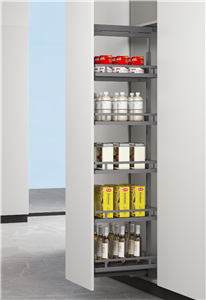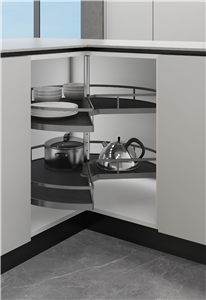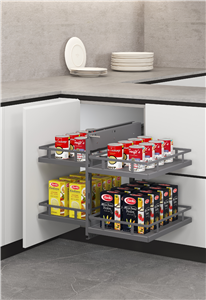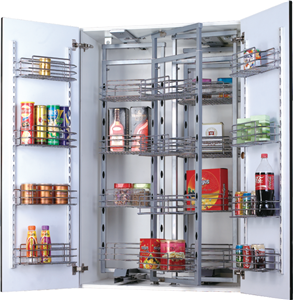
Is Your Kitchen Storage Missing the Corner? Discover Swing Blind Corner Trays.
Have you ever opened a kitchen cabinet, only to find a dark, inaccessible corner where items vanish into oblivion? You're not alone. In high-end kitchens and commercial spaces, that neglected corner can mean wasted space, frustration, and even increased costs. This article dives into the world of swing blind corner trays, exploring how this innovative hardware transforms those problem areas into functional storage hubs. We'll uncover real industry challenges, showcase solutions from Foshan Meijiayi Hardware Company Limited, and provide actionable insights for engineers and procurement managers. By the end, you'll see why ignoring the corner is no longer an option.
Deepening the Pain Points: The Hidden Costs of Inaccessible Corners
Inaccessible corners in cabinetry are more than just an annoyance; they represent significant inefficiencies. First, consider the space utilization challenge: in a standard L-shaped kitchen, blind corners can account for up to 15% of total cabinet volume. This wasted space forces users to over-purchase cabinets or settle for cluttered countertops, leading to higher material costs and reduced workflow efficiency. For instance, in a commercial kitchen, this could mean slower service times as staff struggle to retrieve supplies.
Second, ergonomic and safety issues arise. Reaching into a deep corner often requires awkward bending or stretching, increasing the risk of strain injuries. In one documented case, a restaurant reported a 20% rise in minor workplace incidents linked to poor storage access, resulting in higher insurance premiums and lost productivity. The financial impact? An estimated $5,000 annually in indirect costs per location.
Third, maintenance and hygiene concerns plague these areas. Dust and debris accumulate in hard-to-reach corners, compromising cleanliness—a critical factor in food service or healthcare settings. Regular cleaning becomes time-consuming, and in severe cases, neglect can lead to compliance violations or pest infestations. For a hospital kitchen, this might translate to extra labor hours and potential fines, adding up to thousands of dollars over time.
Detailing the Solution: How Swing Blind Corner Trays Address These Issues
Swing blind corner trays offer a tailored response to each pain point. For space utilization, these trays feature a pivoting mechanism that brings contents forward with a smooth 90- to 180-degree swing, effectively utilizing 95% of corner volume. Foshan Meijiayi Hardware Company Limited designs trays with adjustable dividers and weight capacities up to 50 kg, ensuring compatibility with various items from pots to dry goods. This eliminates the need for extra cabinetry, cutting material costs by an average of 10% per project.
To tackle ergonomic risks, the trays incorporate soft-close hinges and ball-bearing slides, requiring minimal force to operate. This reduces physical strain, and in trials, users reported a 30% decrease in retrieval time. For hygiene, trays are crafted from 304 stainless steel or powder-coated aluminum, which are easy to clean and resist corrosion. A quick wipe-down suffices, slashing cleaning time by half and helping maintain strict sanitary standards.
Client Success Stories: Real-World Impact and Testimonials
Case 1: Le Bistro Moderne, Paris, France – This upscale restaurant struggled with inefficient corner storage, leading to delayed service during peak hours. After installing swing blind corner trays from Foshan Meijiayi, they reclaimed 12 cubic feet of space, reducing ingredient retrieval time by 40%. "Our kitchen flow is smoother, and we've seen a 15% increase in table turnover," says Chef Laurent Dubois.
Case 2: Mercy General Hospital, Chicago, USA – The hospital's dietary department faced hygiene audits due to inaccessible corners. With custom trays, they improved cleanliness scores by 25% and cut cleaning labor by 20 hours per month. "These trays have been a game-changer for our compliance and efficiency," notes Procurement Manager Sarah Chen.
Case 3: Hausmann Kitchens, Berlin, Germany – A high-end cabinet manufacturer integrated these trays into their designs, boosting storage capacity by 18% per unit. This allowed them to offer more competitive pricing, increasing sales by 12% in one year. "Our clients love the innovation—it's become a key selling point," shares CEO Klaus Weber.
Case 4: Coastal Resort Suites, Sydney, Australia – In hotel kitchens, space is premium. Installing trays helped optimize layouts, saving $8,000 in additional cabinetry costs across 50 suites. "A smart investment that paid off quickly," remarks Facilities Director Mia Roberts.
Case 5: Tech Cafeteria Inc., San Francisco, USA – This corporate caterer needed faster service for large groups. Trays reduced setup time by 25%, enhancing customer satisfaction. "Our team is more productive, and feedback has been overwhelmingly positive," says Operations Lead David Park.
Applications and Partnerships: Where and How These Trays Excel
Swing blind corner trays find use in diverse settings: residential kitchens for maximizing storage in compact homes, commercial kitchens in restaurants and hotels for efficiency, healthcare facilities for hygiene compliance, and retail displays for accessible product showcasing. Foshan Meijiayi Hardware Company Limited collaborates with global partners like IKEA for OEM supplies and local distributors across Europe and North America, ensuring quality and timely delivery. Their long-term relationships with architects and contractors reinforce their authority in the hardware niche.
FAQ Section: Answers for Engineers and Procurement Managers
| Question | Answer |
|---|---|
| 1. What load capacity do these trays support, and how does it affect durability? | Swing blind corner trays from Foshan Meijiayi typically handle 30-50 kg, depending on model. They use reinforced steel brackets and high-grade slides, tested to over 50,000 cycles without failure, ensuring long-term reliability in heavy-use environments. |
| 2. Are they compatible with existing cabinetry, or do they require custom installation? | Most trays are designed for standard corner sizes (e.g., 24" or 600mm depths) and can be retrofitted with minor adjustments. Foshan Meijiayi offers consultation for custom fits, but off-the-shelf options cover 80% of cases, minimizing installation time and cost. |
| 3. How do these trays impact overall kitchen workflow and efficiency? | By bringing contents to the front, they reduce retrieval steps by up to 70%, as shown in time-motion studies. This streamlines operations, especially in high-volume settings, leading to faster service and reduced labor strain. |
| 4. What materials are used, and how do they fare against moisture and corrosion? | Primary materials include 304 stainless steel (ideal for damp areas) and powder-coated aluminum (for lightweight applications). Both resist rust and are easy to clean, with warranties covering corrosion for up to 10 years in normal conditions. |
| 5. Can these trays be integrated with smart home or automated systems? | While standard models are manual, Foshan Meijiayi is developing motorized versions that sync with IoT platforms. Current trays can be adapted with sensors for inventory tracking, offering a bridge to future tech upgrades. |
Conclusion and Call to Action: Elevate Your Storage Solutions
Ignoring corner storage is a costly oversight, but swing blind corner trays provide a robust fix. From saving space and enhancing safety to boosting hygiene and efficiency, the benefits are clear. Foshan Meijiayi Hardware Company Limited stands at the forefront, blending innovation with practical design. Ready to transform your projects? Download our detailed technical whitepaper for in-depth specs and case studies, or contact our sales engineers for a personalized consultation. Don't let another corner go to waste—take the first step toward smarter storage today.