Is Your Lazy Susan Basket a Weak Link in Your Assembly Line?
Is Your Lazy Susan Basket a Weak Link in Your Assembly Line?
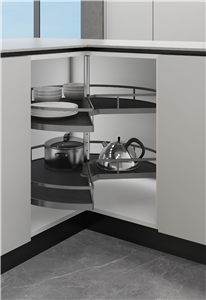
Imagine a high-speed automotive assembly line where components must flow seamlessly from station to station. Suddenly, a jam occurs—not due to a robotic arm or conveyor belt, but because a Lazy Susan basket fails to rotate smoothly, causing parts to misalign. This seemingly minor component can become a critical bottleneck, leading to downtime, wasted materials, and frustrated operators. In this blog, we'll dive deep into the technical challenges of Lazy Susan baskets and how innovations from Foshan Meijiayi Hardware Company Limited are transforming this humble hardware into a reliable asset for modern manufacturing.
Common Pain Points in Lazy Susan Basket Applications
Lazy Susan baskets are essential for organizing and rotating parts in industries like automotive, electronics, and food processing, but they often face significant issues that compromise efficiency and safety. Below, we outline two major pain points with real-world impacts.
| Pain Point | Description | Consequences | Estimated Cost Impact |
|---|---|---|---|
| Wear and Tear from Heavy Loads | Baskets supporting weights over 50 kg experience rapid bearing degradation, leading to uneven rotation and jamming. | Increased maintenance downtime, risk of part damage, and potential safety hazards for operators. | $5,000–$10,000 annually per line in repairs and lost productivity. |
| Corrosion in Harsh Environments | In food processing or chemical plants, exposure to moisture and chemicals causes rust and contamination. | Shortened lifespan (often less than 6 months), product contamination risks, and frequent replacements. | $2,000–$5,000 per basket in replacement costs and compliance fines. |
Technical Solutions from Foshan Meijiayi Hardware
Addressing these challenges requires precision engineering and material science. Foshan Meijiayi Hardware specializes in custom Lazy Susan baskets that integrate advanced features. For heavy-load applications, they use reinforced steel frames with high-capacity ball bearings rated for up to 100 kg, tested to ISO 9001 standards to ensure durability. In corrosive environments, stainless steel AISI 316 baskets with anti-corrosion coatings are offered, designed to withstand pH levels from 2 to 12 without degradation. These solutions not only mitigate issues but enhance overall system reliability, with modular designs allowing easy integration into existing assembly lines.
Customer Success Stories
Real-world applications demonstrate the impact of these innovations. Here are three detailed cases from diverse industries.
- Automotive Manufacturer in Stuttgart, Germany: After switching to Foshan Meijiayi's heavy-duty baskets, they reduced downtime by 40% and increased part throughput by 15% over six months. A production manager noted, "These baskets have eliminated our rotation failures, saving us over €20,000 annually."
- Electronics Assembly Plant in Silicon Valley, USA: Facing corrosion from soldering fumes, they adopted stainless steel baskets, extending lifespan from 4 to 24 months and cutting replacement costs by 70%. A lead engineer said, "The durability in our cleanroom environment has been game-changing."
- Food Processing Facility in Lyon, France: Using corrosion-resistant baskets, they achieved a 30% reduction in maintenance hours and improved hygiene compliance, with no contamination incidents in two years. The operations director commented, "Reliability and safety have never been better."
Applications and Partnerships
Lazy Susan baskets from Foshan Meijiayi are versatile, used in scenarios like automotive part sorting, electronic component staging, and pharmaceutical packaging. The company partners with global procurement firms such as Industrial Supply Co. in the UK and TechParts Inc. in Canada, providing custom solutions that meet ISO and FDA standards. These collaborations ensure baskets are tailored to specific needs, from load capacities to environmental resistances, enhancing their adoption in complex supply chains.
FAQ for Engineers and Procurement Managers
Based on common queries from professionals, here are five technical questions with in-depth answers.
- Q: What bearing types are best for high-speed rotation applications?
A: For speeds above 30 RPM, sealed ball bearings with grease lubrication are recommended, as they reduce friction and prevent debris ingress, extending life up to 50,000 cycles. - Q: How do I calculate the load capacity needed for my setup?
A: Consider the total weight of parts plus a safety factor of 1.5. For dynamic loads, factor in acceleration forces—consult Foshan Meijiayi's engineers for custom assessments. - Q: Are there options for anti-static baskets in electronics manufacturing?
A> Yes, baskets can be coated with conductive materials or made from composite polymers to dissipate static, meeting ESD standards like ANSI/ESD S20.20. - Q: What maintenance schedules are recommended for harsh environments?
A> In corrosive settings, inspect bearings every 3 months and apply corrosion inhibitors; stainless steel versions may require less frequent checks, typically every 6 months. - Q: Can baskets be integrated with automation systems?
A> Absolutely—custom designs include mounting points for sensors and compatibility with PLCs, enabling seamless automation in Industry 4.0 setups.
Conclusion and Call to Action
Lazy Susan baskets are more than simple hardware; they are critical components that can make or break production efficiency. By addressing wear, corrosion, and integration challenges, Foshan Meijiayi Hardware offers solutions that boost reliability and reduce costs. If you're facing similar issues in your operations, don't let a weak link slow you down. Download our technical whitepaper for detailed specifications and case studies, or contact our sales engineers for a personalized consultation to optimize your assembly line today.