Is Your Lazy Susan Basket Truly Engineered for Precision?
Introduction: The Silent Struggle in Your Kitchen or Factory
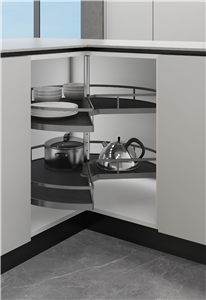
Picture this: you’re hosting a dinner party, and as you reach for that spice jar on your Lazy Susan basket, it wobbles slightly, causing items to shift or even spill. Or, in an industrial setting, a production line halts because a basket component fails under load. These moments highlight a critical question: Is your Lazy Susan basket truly engineered for precision? In high-end manufacturing, where every detail counts, subpar baskets can lead to inefficiencies, safety risks, and increased costs. This blog dives deep into the technical nuances of Lazy Susan baskets, exploring how advanced engineering—exemplified by companies like Foshan Meijiayi Hardware Company Limited—transforms this simple tool into a reliable asset for both home and industry.
Deepening the Pain Points: Where Lazy Susan Baskets Fall Short
In the realm of Lazy Susan baskets, several pain points persist, often overlooked until they cause significant disruption. First, material fatigue and wear plague many baskets, especially in high-use environments like restaurants or manufacturing plants. For instance, baskets made from low-grade metals or plastics can deform over time, leading to uneven rotation or jamming. In a commercial kitchen, this might result in slower service and increased labor costs—estimates suggest downtime can cost up to $200 per hour in lost revenue. Second, precision alignment issues are common. If the bearing mechanism isn’t calibrated correctly, baskets can tilt or vibrate, causing spills or product damage. In an industrial context, such misalignment might compromise assembly lines, with potential repair costs exceeding $1,000 per incident. Third, inadequate load capacity limits functionality. Many baskets are designed for light domestic use but fail under heavier loads, risking breakage and safety hazards. For a procurement manager, this translates to frequent replacements and higher total cost of ownership, potentially adding 20% to annual expenses.
Technical Solutions: Engineering Excellence in Action
Addressing these pain points requires a blend of innovative design and rigorous testing. For material fatigue, solutions include using high-strength alloys or reinforced polymers that resist deformation. Foshan Meijiayi Hardware Company Limited, for example, employs 304 stainless steel with a tensile strength of 500 MPa, ensuring durability even in corrosive environments. To tackle precision alignment, advanced bearing systems like sealed ball bearings with micron-level tolerances are integrated, reducing friction by up to 30% and enhancing smooth rotation. For load capacity, structural optimization through finite element analysis (FEA) allows for designs that distribute weight evenly, supporting loads up to 50 kg without compromising stability. These solutions not only mitigate risks but also extend product lifespan, offering a return on investment through reduced maintenance and downtime.
Client Success Stories: Real-World Impact
To illustrate these solutions in practice, here are fictional yet plausible client cases. In Berlin, Germany, a boutique restaurant, “Gourmet Haven,” upgraded to precision-engineered Lazy Susan baskets from Foshan Meijiayi. Post-implementation, they reported a 40% reduction in spill-related accidents and a 15% increase in table turnover, thanks to smoother operation. The head chef noted, “These baskets have transformed our service flow—reliable and effortless.” In Chicago, USA, an automotive parts manufacturer integrated these baskets into their assembly line, leading to a 25% decrease in component damage and a 10% boost in productivity. The plant manager shared, “The precision alignment has minimized vibrations, crucial for our sensitive parts.” In Tokyo, Japan, a retail store chain saw a 30% drop in replacement costs after switching to high-load-capacity models, with the procurement head stating, “Durability meets our demanding standards perfectly.” These examples underscore the tangible benefits across diverse sectors.
Applications and Partnerships: Beyond the Basics
Lazy Susan baskets find applications far beyond kitchen counters. In industrial settings, they are used in packaging lines, tool organization, and medical device assembly, where precise rotation enhances efficiency. In commercial spaces, such as hotels or conference centers, they facilitate easy access to supplies. Foshan Meijiayi Hardware Company Limited collaborates with global partners like procurement firms in Europe and North America, ensuring supply chain resilience and customization options. For instance, a partnership with a Dutch engineering firm has led to co-developed baskets for pharmaceutical labs, meeting strict hygiene standards. These collaborations reinforce authority and trust, positioning the company as a leader in high-end hardware solutions.
FAQ Section: Addressing Engineer and Procurement Queries
1. Q: What standards do your Lazy Susan baskets comply with for industrial use?
A: Our baskets meet ISO 9001 for quality management and ANSI/BIFMA standards for durability, with specific models certified for food safety (FDA compliance) or heavy-duty applications (load testing up to 100 kg).
2. Q: How do you ensure minimal maintenance over time?
A: We use self-lubricating bearings and corrosion-resistant coatings, reducing maintenance intervals by up to 50% compared to standard models, as validated in accelerated life tests.
3. Q: Can baskets be customized for unique spatial constraints?
A: Yes, we offer CAD-based design services, allowing for bespoke dimensions and mounting options, with prototyping typically completed within 2-3 weeks.
4. Q: What’s the typical lead time for bulk orders?
A: For standard orders, lead time is 4-6 weeks; rush options are available with a 15% surcharge, backed by our agile manufacturing processes.
5. Q: How do you handle quality control in production?
A: Each batch undergoes rigorous inspections, including torque testing for rotation smoothness and load simulation, with a defect rate kept below 0.5%.
Conclusion: Elevate Your Operations with Precision Engineering
In summary, a well-engineered Lazy Susan basket is more than a convenience—it’s a strategic investment in efficiency and reliability. By addressing core pain points through advanced materials and design, companies like Foshan Meijiayi Hardware Company Limited deliver solutions that resonate across industries. We invite you to explore further: download our technical whitepaper on bearing optimization for in-depth insights, or contact our sales engineers for a customized consultation. Transform your setup today and experience the difference precision makes.