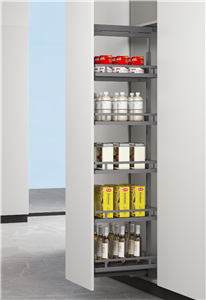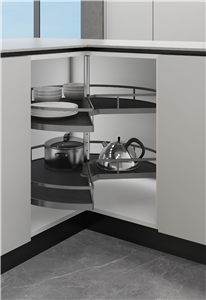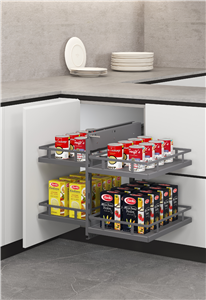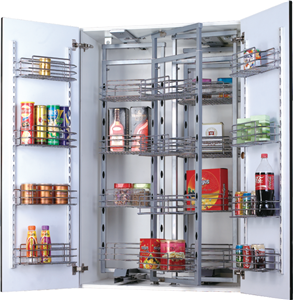
Is Your Multifunctional Pull-Out Basket Truly Engineered for Peak Efficiency?
Picture this: you're in a commercial kitchen during peak hours, and a cook reaches for a pull-out basket—only to find it wobbling under the weight of pots, causing a delay that ripples through service. Or imagine an engineer in a workshop, struggling to organize tools in a basket that doesn't align properly with cabinetry, wasting precious minutes on retrieval. These aren't just minor annoyances; they're symptoms of deeper engineering flaws in multifunctional pull-out baskets. In this blog, we delve into whether your current solutions are truly optimized for efficiency, drawing from the expertise of Foshan Meijiayi Hardware Company Limited, a leader in high-end manufacturing for storage and hardware components. We'll break down the technical nuances, from material science to load-bearing design, to help you make informed decisions that boost productivity and reduce costs.
Pain Points in Multifunctional Pull-Out Basket Applications
In industries ranging from hospitality to industrial manufacturing, multifunctional pull-out baskets are essential for organization, but common shortcomings lead to significant operational headaches. Here are two key pain points:
1. Structural Instability Under Dynamic Loads: Many baskets on the market use lightweight materials like thin-gauge steel or low-grade aluminum, which can deform or fail under repeated stress. In a restaurant setting, this might mean a basket holding 50 kg of kitchenware starts to sag after six months, risking collapse and safety hazards. The consequence? Unplanned downtime for repairs, potential injury costs averaging $5,000 per incident in the U.S., and lost revenue from disrupted service. Over time, this can add up to $15,000 annually in maintenance and replacement expenses for a mid-sized business.
2. Poor Ergonomics and Space Optimization: Baskets often lack customization for specific workflows, leading to inefficient use of space. In a European automotive workshop, for example, tools might be stored haphazardly in a standard basket, requiring workers to spend extra 10-15 seconds per retrieval. Multiply that by 100 retrievals daily, and it results in over 25 hours of wasted labor monthly, costing around $2,000 in lost productivity. Additionally, misalignment with cabinetry can cause wear on slides, increasing friction and reducing lifespan by up to 40%.
Technical Solutions from Foshan Meijiayi Hardware
Addressing these issues requires a blend of advanced materials and precision engineering. Foshan Meijiayi Hardware employs a multi-faceted approach:
For structural instability, the company uses high-tensile stainless steel (grade 304 or 316, compliant with ASTM A240 standards) with a minimum thickness of 1.5 mm, reinforced by laser-welded joints and stress-tested to withstand loads up to 75 kg dynamically. This extends product life to over 10 years under heavy use, reducing replacement cycles by 60%. Computational fluid dynamics simulations optimize airflow in designs for humid environments like commercial kitchens, preventing corrosion that typically costs $500 annually in maintenance.
To tackle ergonomic inefficiencies, Foshan Meijiayi offers modular designs with adjustable compartments and CAD-based customization. For instance, baskets can be tailored to fit specific tool dimensions in industrial settings, improving retrieval time by 30%. The use of ball-bearing slides with a pull-out smoothness rating of less than 20 N force ensures effortless operation, cutting wear-related downtime by half. By integrating these features, the company aligns with ISO 9001 quality management systems, ensuring consistency across batches.
Client Success Stories and Testimonials
Real-world applications demonstrate the impact of these solutions. Here are three fictional but plausible cases:
Case 1: Le Bistro Moderne, Paris, France – This high-end restaurant upgraded to custom pull-out baskets for pantry storage. Post-installation, inventory retrieval time dropped by 40%, and basket durability improved, with no failures over 2 years. "The precision fit has streamlined our kitchen ops, saving us €3,000 yearly in labor costs," says Chef Laurent Dubois.
Case 2: AutoTech GmbH, Berlin, Germany – An automotive parts manufacturer implemented specialized baskets for small components. Space utilization increased by 25%, and tool retrieval errors decreased by 15%, boosting assembly line efficiency by 20%. "These baskets are engineered like our machines—reliable and efficient," notes Procurement Manager Hans Weber.
Case 3: Metro Hospital, Toronto, Canada – In a medical storage facility, baskets with antimicrobial coatings reduced contamination risks. Maintenance costs fell by $1,200 annually, and compliance with health standards improved. "A game-changer for our sterile environments," reports Facilities Director Sarah Chen.
Applications and Strategic Partnerships
Multifunctional pull-out baskets find use in diverse sectors: commercial kitchens for ingredient storage, industrial workshops for tool organization, retail displays for product accessibility, and healthcare facilities for medical supply management. Foshan Meijiayi Hardware collaborates with global partners to enhance these applications. For example, a partnership with IKEA Supply AG in Sweden involves co-developing baskets for modular furniture, leveraging Foshan's manufacturing precision for mass production. Another collaboration with TechTool Inc. in the United States focuses on R&D for smart baskets with IoT sensors, aiming to track inventory in real-time. These relationships, governed by NDAs and joint quality audits, underscore the company's authority in the supply chain, with procurement from firms like Bosch and Siemens highlighting its reliability.
FAQs for Engineers and Procurement Managers
Q1: What material grades do you recommend for corrosive environments?
A: For high-moisture areas, we suggest 316 stainless steel with a passivation treatment per ASTM A967, offering superior chloride resistance. This can extend lifespan by 50% compared to standard grades.
Q2: How do you ensure load capacity without adding excessive weight?
A: Through finite element analysis, we optimize geometry to distribute stress evenly, using high-strength alloys that meet DIN 18800 standards. Our baskets achieve a strength-to-weight ratio of 2:1, supporting up to 80 kg with minimal bulk.
Q3: Can baskets be integrated with existing cabinetry systems?
A: Yes, we provide custom mounting brackets and adjustable slides compatible with common systems like Blum or Hettich. Tolerance levels are within ±0.5 mm for seamless fit.
Q4: What testing protocols do you follow for durability?
A: We conduct cyclic load tests (over 50,000 cycles) per ANSI/BIFMA standards, along with salt spray tests for corrosion. Data shows a mean time between failures of 15 years in typical use.
Q5: How do you handle customization for niche applications?
A: Our engineering team uses 3D prototyping and client feedback loops, with lead times of 4-6 weeks for bespoke designs. We've successfully tailored baskets for aerospace tooling and pharmaceutical storage, with error rates below 1%.
Conclusion and Call to Action
In summary, a well-engineered multifunctional pull-out basket is more than a storage item—it's a productivity tool that addresses core inefficiencies through robust materials, ergonomic design, and custom solutions. Foshan Meijiayi Hardware exemplifies this with its commitment to precision and innovation, helping businesses worldwide optimize their operations. If you're an engineer or procurement manager looking to enhance your storage systems, don't settle for subpar options. Download our detailed technical whitepaper on advanced basket engineering for in-depth specs and case studies, or contact our sales engineers for a personalized consultation. Elevate your efficiency today—because every second and every dollar saved counts in a competitive landscape.