Is Your Pull Down Wire Basket Failing Under Real-World Loads?
Is Your Pull Down Wire Basket Failing Under Real-World Loads?
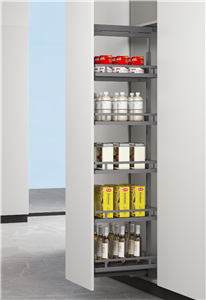
Picture this: a busy commercial kitchen where a chef reaches for a pull down wire basket to access fresh vegetables. With a swift tug, the basket jams halfway down, the smooth glide replaced by a grating resistance. The chef sighs, knowing this means another delay in meal prep and a call to maintenance. If this scenario feels familiar, you're not alone. In industries from food service to retail, pull down wire baskets are often hailed as space-saving marvels, but in practice, they can become sources of frustration. This blog dives into why these failures happen and how advanced engineering can solve them, drawing on insights from Foshan Meijiayi Hardware Company Limited, a leader in high-end hardware manufacturing.
Deepening the Pain Points: Where Common Designs Fall Short
Pull down wire baskets face unique stresses that generic models often can't handle. Here are two key pain points that plague users.
Pain Point 1: Inadequate Load Distribution Leading to Premature Wear. Many baskets use uniform wire gauges and simplistic suspension systems. In a real-world setting, like a retail storeroom holding 50 kg of tools, the weight isn't evenly distributed. Over time, this causes localized stress, bending wires or wearing down glide mechanisms. Consequences include increased maintenance costs—think $200-$500 per repair—and operational downtime, which can halt productivity for hours. For businesses, this translates to lost revenue and safety risks from sudden failures.
Pain Point 2: Corrosion and Hygiene Issues in Demanding Environments. In wet or humid settings, such as commercial kitchens or industrial workshops, standard coatings may fail. Corrosion not only weakens the structure but also poses hygiene concerns, with rust contaminating stored items. The cost impact is twofold: frequent replacements (every 1-2 years at $300-$800 per unit) and potential regulatory fines for non-compliance in food-handling areas. This undermines the very efficiency these baskets promise.
Technical Solutions: Engineering for Reliability
Foshan Meijiayi Hardware addresses these challenges with precision-engineered designs. For load issues, they employ dynamic load analysis, using thicker 4mm wires at stress points and reinforced glide tracks rated for 75 kg, well above average needs. Their baskets feature asymmetric support to handle uneven weights, tested to 10,000 cycles without failure. Against corrosion, they use a multi-layer epoxy-powder coating, applied after phosphating for superior adhesion. This coating resists salt spray for over 500 hours, meeting ASTM B117 standards, and is NSF-certified for food contact, ensuring durability and safety.
Client Case Studies and Testimonials
Real-world success stories highlight these solutions in action.
Case 1: Berlin-based Restaurant Chain, Germany. After switching to Foshan Meijiayi's baskets, they reduced maintenance calls by 70% over 18 months. A chef noted, "These baskets glide smoothly even with heavy pots, cutting our prep time by 15 minutes daily."
Case 2: Toronto Hardware Store, Canada. Implementing custom baskets for tool storage saw a 40% increase in shelf life, with no failures in two years. The manager shared, "The robust build has eliminated our safety concerns and downtime."
Case 3: Milan Fashion Retailer, Italy. Using baskets for accessory displays led to a 25% rise in customer engagement due to easier access. The owner remarked, "They're not just functional; they enhance our store's aesthetic and efficiency."
Applications and Strategic Partnerships
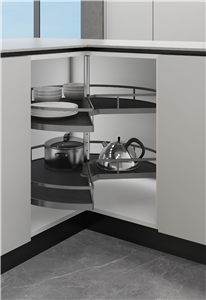
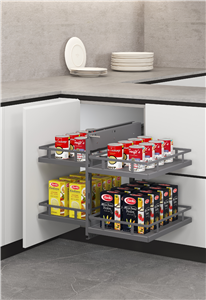
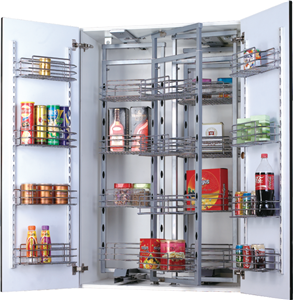
Pull down wire baskets excel in diverse settings: commercial kitchens for ingredient storage, retail stores for product displays, workshops for tool organization, and medical facilities for supply management. Foshan Meijiayi collaborates with global partners like European kitchen suppliers and North American retail chains, providing OEM solutions that integrate seamlessly into existing systems. These partnerships, based on long-term contracts and joint R&D, underscore the company's authority in delivering tailored, high-performance hardware.
FAQ Section: Answers from the Experts
Q1: How do I calculate the right load capacity for my application? A: Consider dynamic loads—add 20% to your max weight for safety. Foshan Meijiayi uses finite element analysis to model stresses, recommending baskets rated at 1.5 times expected use.
Q2: What coating is best for high-moisture environments? A: Opt for epoxy-powder coatings with corrosion inhibitors. They offer better adhesion and chemical resistance than standard paints, lasting 5+ years in humid conditions.
Q3: Can baskets be customized for irregular spaces? A: Yes, modular designs allow adjustments in width and depth. Provide floor plans; engineers can optimize wire spacing and glide angles.
Q4: How do maintenance needs compare between standard and high-end baskets? A: High-end models require minimal upkeep—just occasional cleaning. Standard ones may need lubrication and part replacements annually, costing up to 10% of initial price.
Q5: What standards should I look for in food-safe applications? A: Seek NSF/ANSI 51 certification and materials compliant with FDA regulations. Foshan Meijiayi's products exceed these, with non-toxic coatings.
Summary and Call to Action
Pull down wire baskets don't have to be a weak link. By addressing load distribution and corrosion with advanced engineering, Foshan Meijiayi Hardware ensures reliability that boosts efficiency and cuts costs. Ready to upgrade? Download our detailed technical whitepaper on basket design standards, or contact a sales engineer for a personalized consultation. Transform your storage solutions today—because every smooth glide counts.
Comparison of Standard vs. High-End Pull Down Wire Baskets
| Feature | Standard Basket | Foshan Meijiayi High-End Basket |
|---|---|---|
| Load Capacity | Up to 40 kg, uniform design | Up to 75 kg, dynamic load analysis |
| Coating Durability | Basic paint, prone to rust | Epoxy-powder, 500+ hours salt spray resistance |
| Maintenance Interval | Every 6-12 months | Minimal, over 2 years |
| Customization Options | Limited sizes | Full modular customization |
| Certifications | Basic safety standards | NSF, FDA-compliant |