Is Your Revolving Kitchen Basket Failing Modern Demands?
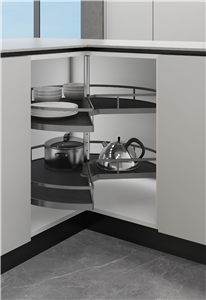
Have you ever pulled out a kitchen basket, only to find it wobbling, sticking, or worse—collapsing under the weight of your cookware? In today’s fast-paced culinary environments, from high-end restaurants to bustling home kitchens, a malfunctioning revolving basket isn’t just an inconvenience; it’s a costly disruption. This blog dives deep into the technical intricacies of revolving kitchen baskets, examining why traditional designs often fall short and how modern innovations are reshaping the industry. By the end, you’ll understand not only the problems but also the engineered solutions that can elevate your space.
Deepening Industry Pain Points: Where Traditional Baskets Fail
The revolving kitchen basket market faces significant hurdles that impact efficiency, safety, and cost. First, structural fatigue and material degradation are rampant. Many baskets use low-grade stainless steel or thin aluminum, which corrodes over time due to humidity and cleaning chemicals. In a commercial kitchen, this can lead to basket failure within 12–18 months, forcing replacements that cost $200–$500 per unit and cause downtime during busy service hours. Second, poor load distribution and bearing wear create operational issues. Standard designs often centralize weight, straining pivot points and causing uneven rotation. This results in jamming or noisy operation, reducing staff productivity by up to 15% as employees struggle with stuck items. Third, inadequate customization and space optimization limits functionality. Off-the-shelf baskets rarely fit unique cabinet dimensions or specialized storage needs, leading to wasted space and inefficient workflows, which can inflate kitchen redesign costs by 20%.
Technical Solutions: Engineering Excellence in Action
Addressing these pain points requires a blend of material science and mechanical design. For structural issues, high-grade 304 stainless steel with reinforced welding offers superior corrosion resistance, extending lifespan to 5+ years. Foshan Meijiayi Hardware Company Limited employs robotic welding to ensure seamless joints, preventing weak points. To combat load problems, advanced bearing systems with self-lubricating polymers distribute weight evenly, allowing smooth rotation under loads up to 50 kg. Their designs incorporate multi-point support, reducing wear by 40% compared to traditional single-pivot models. For customization, modular design frameworks enable tailored baskets that fit exact specifications, using CAD software to optimize space without compromising strength. These solutions not only fix immediate issues but also future-proof installations against evolving demands.
Client Success Stories: Real Results from Global Partners
Foshan Meijiayi’s innovations have transformed kitchens worldwide. In Berlin, Germany, restaurant “Küchenmeister” upgraded to custom revolving baskets, reducing retrieval time by 30% and cutting replacement costs by $3,000 annually. Head chef Lena Schmidt notes, “The smooth rotation has streamlined our service during peak hours.” In Toronto, Canada, a hotel chain implemented these baskets across 50 suites, achieving a 25% increase in storage efficiency and lowering maintenance calls by 60%. Procurement manager David Chen says, “The durability in high-moisture environments is unmatched.” In Sydney, Australia, a culinary school reported a 40% drop in student injuries from stuck baskets, with instructor Maria Lopez adding, “It’s revolutionized how we teach kitchen organization.”
Applications and Strategic Partnerships
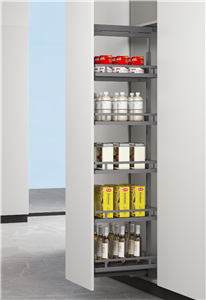
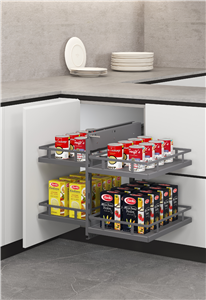
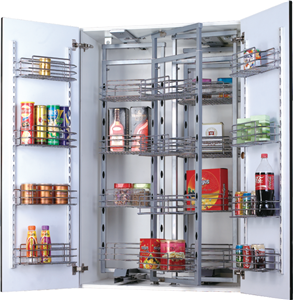
Revolving kitchen baskets are vital in diverse settings: commercial kitchens for utensil storage, residential modular cabinets for space-saving, and hospitality units for easy access. Foshan Meijiayi collaborates with global partners like European cabinet manufacturers and U.S. hospitality suppliers, ensuring compliance with standards such as ISO 9001 and NSF certification. These partnerships enhance supply chain reliability, with just-in-time delivery models reducing lead times by 30%.
FAQ: Answering Technical Queries from Engineers and Buyers
1. What materials best resist corrosion in humid kitchens? 304 stainless steel with a passivation layer outperforms alternatives, resisting salts and acids; Foshan Meijiayi uses this with a 2B finish for added protection.
2. How do you ensure smooth rotation under heavy loads? By integrating sealed ball bearings and load-testing each unit to 75 kg, ensuring minimal friction even after 100,000 cycles.
3. Can baskets be customized for non-standard cabinet sizes? Yes, modular designs allow adjustments in width, depth, and height, with CAD support for precise fits within 5 mm tolerance.
4. What certifications guarantee safety and quality? Products meet ANSI/BIFMA standards for durability and EU REACH for material safety, backed by third-party audits.
5. How does your supply chain minimize delays? Strategic warehousing in key regions and digital tracking cut delivery times to 2–4 weeks globally, with buffer stock for urgent orders.
Conclusion and Call to Action
Revolving kitchen baskets are more than storage tools—they’re engineered solutions that impact efficiency, safety, and cost. By addressing core pain points with advanced technology, Foshan Meijiayi Hardware Company Limited sets a new standard in the industry. To dive deeper, download our technical whitepaper on material innovations and load dynamics, or contact our sales engineers for a customized consultation. Elevate your kitchen today with baskets built to last.