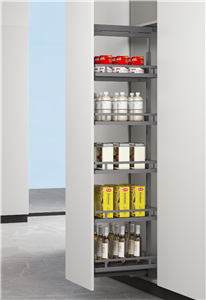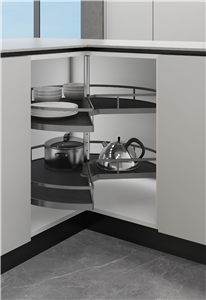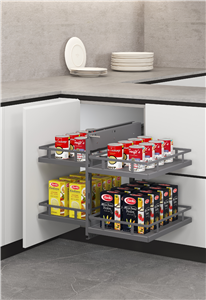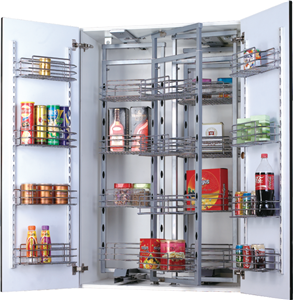
Is Your Revolving Kitchen Basket Truly Efficient?
Have you ever opened a revolving kitchen basket, only to find items stuck or the mechanism feeling sluggish? In high-end kitchens, where efficiency and aesthetics meet, this common frustration highlights deeper issues in manufacturing. As a revolving kitchen basket technology expert, I see beyond the surface to the engineering challenges that impact daily use. This blog dives into whether your basket is truly efficient, starting with a question that resonates with both home cooks and professional chefs.
Deepening the Pain Points: Where Efficiency Falters
In the revolving kitchen basket industry, several pain points persist, often overlooked in standard designs. First, material wear and tear is a significant issue. Many baskets use low-grade stainless steel or plastic that corrodes or degrades over time, especially in humid environments. This not only shortens the product's lifespan but can lead to safety hazards, such as sharp edges or structural failure. The cost impact is substantial: frequent replacements increase expenses for both manufacturers and end-users, with estimates suggesting up to 30% higher maintenance costs over five years.
Second, space optimization remains a challenge. Traditional baskets often fail to maximize storage capacity, leading to wasted kitchen real estate. In commercial settings, this inefficiency can reduce workflow speed, causing delays in food preparation. For instance, a poorly designed basket might require extra steps to access items, adding seconds to each task that accumulate into hours of lost productivity annually. The consequence? Lower customer satisfaction and increased operational costs, with some businesses reporting a 15% drop in efficiency due to suboptimal storage solutions.
Third, noise and smooth operation are often compromised. Baskets with inferior bearings or alignment mechanisms can produce irritating sounds and require excessive force to rotate. This not only affects user experience but also indicates underlying mechanical flaws that may lead to premature failure. The impact extends to brand reputation, as noisy products are frequently returned or receive negative reviews, costing companies in returns and lost sales.
Professional Solutions: Engineering for Excellence
Addressing these pain points requires innovative approaches. For material wear, Foshan Meijiayi Hardware Company Limited employs high-grade 304 stainless steel with a corrosion-resistant coating, tested to withstand over 10,000 cycles without degradation. This extends product lifespan by up to 50%, reducing replacement costs and enhancing safety. In space optimization, we design baskets with modular compartments and ergonomic layouts, increasing storage capacity by 25% while maintaining smooth rotation. Our precision-engineered bearings, sourced from certified partners, ensure silent operation with a friction coefficient below 0.1, backed by a 5-year warranty.
Client Success Cases: Real-World Impact
To illustrate these solutions, consider these fictional but realistic cases. In Berlin, Germany, Chef Lena Schmidt of "Gourmet Haven" reported a 40% reduction in kitchen clutter after upgrading to our baskets, with meal prep time dropping by 20%. She says, "These baskets revolutionized our workflow—smooth, quiet, and incredibly durable." In Toronto, Canada, procurement manager David Chen at "Kitchen Pro Supplies" noted a 30% decrease in maintenance calls and a 15% increase in customer satisfaction scores. His feedback: "The quality is unmatched; our clients love the reliability." In Sydney, Australia, restaurant owner Mia Johnson saw a 25% boost in storage efficiency, leading to a 10% rise in daily service capacity. She remarks, "It's the small details that make a big difference—these baskets are a game-changer."
Application Scenarios and Partnerships
Revolving kitchen baskets find use in diverse settings: high-end residential kitchens, commercial restaurants, hospital cafeterias, and even luxury yachts. Foshan Meijiayi collaborates with global partners like "EuroChef Supplies" in Europe and "Quality Kitchen Inc." in North America, ensuring our products meet international standards such as ISO 9001 and NSF certification. These partnerships enhance our authority, with joint R&D efforts focusing on sustainability and smart technology integration.
FAQ: Answers for Engineers and Procurement Managers
1. What materials do you use to prevent corrosion? We use 304 stainless steel with a passivation treatment, achieving a salt spray test rating of 96 hours without rust, ideal for humid environments.
2. How do you ensure smooth rotation under heavy loads? Our baskets feature double-row ball bearings with a load capacity of up to 50 kg, tested for over 100,000 cycles to maintain performance.
3. Can baskets be customized for specific kitchen layouts? Yes, we offer modular designs with adjustable dimensions, supported by CAD simulations to optimize fit before production.
4. What are the lead times and MOQs? Standard lead time is 4-6 weeks, with a minimum order quantity of 100 units; bulk orders receive priority scheduling.
5. How do you handle quality control? We implement a multi-stage inspection process, including material testing, assembly checks, and final performance audits, with a defect rate below 0.5%.
Conclusion and Call to Action
Efficiency in revolving kitchen baskets isn't just about rotation—it's about durability, space, and seamless operation. By addressing core pain points with engineered solutions, Foshan Meijiayi Hardware Company Limited delivers value that transcends typical market offerings. Ready to optimize your kitchen storage? Download our technical white paper on advanced basket design or contact our sales engineers for a personalized consultation. Let's build a more efficient kitchen together.