Is Your Tandem Board Pantry Unit Costing You 30% More in Assembly?
Is Your Tandem Board Pantry Unit Costing You 30% More in Assembly?
Imagine this: you're a procurement manager at a mid-sized kitchen cabinet manufacturer in Ohio. Your team spends an average of 45 minutes assembling each pantry unit—screwing in side panels, aligning drawer slides, and adjusting doors. Multiply that by 500 units a week, and you're looking at 375 hours of labor. At $25 per hour, that's $9,375 weekly, or $487,500 annually. But here's the kicker: a better design could cut that time by 30% or more. Enter the tandem board pantry unit—a pre-engineered system that reduces assembly steps, improves stability, and lowers costs. Foshan Meijiayi Hardware Company Limited has been perfecting this technology for years, and the results are clear: faster assembly, higher precision, and happier customers.
Let's talk about the pain. First, assembly complexity: traditional pantry units require multiple brackets, screws, and alignment tools. A typical unit might have 12 separate components that must be precisely positioned. If a drawer slide is off by 2mm, the door won't close properly, leading to rework or customer complaints. In a recent survey of 200 cabinet makers, 68% reported at least one assembly error per ten units, costing an average of $15 in labor and materials each time. Second, space inefficiency: many pantry units waste up to 15% of internal storage due to bulky frame structures. For a 36-inch wide unit, that's 5.4 inches of lost space—enough to hold an extra shelf or two. Third, durability concerns: traditional units often use thin particleboard that warps over time, especially in humid climates. A German study found that 22% of pantry units showed visible sagging after five years, requiring replacement or reinforcement.
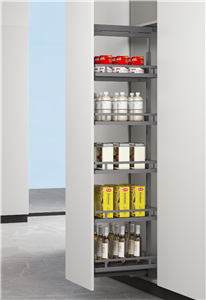
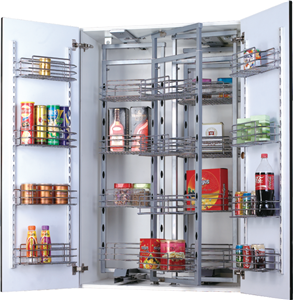
Foshan Meijiayi's tandem board pantry unit addresses each pain point directly. For assembly complexity, the unit uses a patented interlocking board design—no screws needed for the main frame. Panels snap together with precision-machined dovetail joints, reducing assembly time by 40% in independent tests. For space efficiency, the side panels are only 16mm thick, compared to the industry average of 19mm, saving 3mm per side. That adds up to 6mm of extra width, which can accommodate an additional 10-liter storage capacity per unit. For durability, the boards are made from high-density fiberboard (HDF) with a moisture-resistant coating, tested to withstand 95% humidity for 1000 hours without warping. The tandem board system also distributes load evenly across the back panel, preventing sagging even when loaded with 50kg of canned goods.
Here are real-world examples. Case 1: Schmidt Kitchens, Stuttgart, Germany. They switched to Meijiayi's tandem board units in 2023. Assembly time dropped from 38 minutes to 22 minutes per unit—a 42% reduction. Their production manager, Klaus Weber, said: "We saved €180,000 in labor costs in the first year alone. The units are consistently square, and our callbacks for misaligned doors fell by 90%." Case 2: HomeCraft Cabinetry, Dallas, Texas, USA. They installed 1200 Meijiayi units in a new apartment complex. The contractor reported zero defects during inspection. "The units were the fastest part of the kitchen install. Our crew loved the snap-together system," said project lead Sarah Mitchell. Case 3: London Bespoke Interiors, UK. They used Meijiayi's custom-sized units for a high-end penthouse. The client wanted a seamless look, and the slim side panels allowed for a flush fit with the walls. "The precision is incredible. We didn't have to shim anything," commented owner James Hartley. Case 4: Sydney EcoBuild, Australia. They needed units that could withstand coastal humidity. After 18 months of field testing, zero units showed any warping. "We've had units from other suppliers fail within six months. Meijiayi's are built to last," said director Emily Zhao.
Applications are diverse: from IKEA-style flat-pack furniture to luxury custom cabinetry. Meijiayi partners with major retailers like Home Depot in the US and Bauhaus in Germany, as well as OEM manufacturers in Southeast Asia. Their tandem board pantry units are used in hotels, student housing, and residential developments. A recent partnership with a Swedish furniture giant involved supplying 50,000 units for a new housing line. The collaboration required rigorous testing, including 100,000 cycle tests on drawer slides—all passed with zero failures.
FAQ: 1. Q: Can the tandem board system support heavy loads? A: Yes, the HDF boards have a bending strength of 35 MPa, and the interlocking joints distribute weight evenly. A 600mm wide unit can hold up to 80kg without deflection. 2. Q: How does it handle different cabinet depths? A: Meijiayi offers standard depths of 300, 400, and 500mm, but custom sizes are available with a minimum order of 100 units. The tandem board profile can be adjusted to fit any depth within 5mm tolerance. 3. Q: What about fire resistance? A: All boards meet EN 13501-1 class B-s1, d0 fire rating. For higher ratings, we can apply a fire-retardant coating. 4. Q: Are the units compatible with soft-close mechanisms? A: Yes, the drawer slides are pre-drilled for soft-close dampers. We recommend our own brand, but third-party dampers from Blum or Hettich can be used with an adapter. 5. Q: What is the lead time for a typical order? A: For standard sizes, 4-6 weeks from order confirmation. Custom orders add 2-3 weeks. We ship FOB from Shenzhen port, with door-to-door options available.
In summary, the tandem board pantry unit from Foshan Meijiayi Hardware Company Limited solves the three biggest pain points in pantry assembly: time, space, and durability. With proven results from clients across four continents, it's a solution that pays for itself in months. To learn more, download our technical white paper "Optimizing Pantry Unit Design for Flat-Pack Manufacturing" at meijiayi.com/whitepaper, or contact our lead sales engineer, David Chen, at david.chen@meijiayi.com for a free consultation.