Is Your Warehouse Storage Really Optimized for Efficiency?
Imagine walking into a warehouse where every storage aisle requires forklifts to navigate, workers spend extra minutes searching for items, and valuable vertical space remains unused. This common scenario highlights a critical question: Is your warehouse storage truly optimized for maximum efficiency? As storage needs evolve in manufacturing and logistics, traditional fixed shelving systems often fall short. This article explores how pull-out storage rack shelves provide intelligent solutions to persistent industry challenges.
Identifying Core Industry Pain Points
The first major challenge is poor space utilization. In traditional warehouses, fixed shelves create permanent aisles that consume 40-50% of floor space. A 10,000-square-foot facility might effectively use only 5,000-6,000 square feet for actual storage. This wasted space translates directly to higher real estate costs—approximately $15-$30 per square foot annually in industrial areas—and limits expansion capacity without costly relocation.
Operational inefficiency represents another significant pain point. Workers accessing items on fixed shelves often require:
- Additional walking time between aisles
- Frequent repositioning of forklifts
- Multiple handling steps for retrieval
Studies show these inefficiencies add 15-20 minutes per worker per shift in retrieval time alone. For a facility with 50 warehouse employees, this equals 125-167 lost hours weekly, equivalent to 3-4 full-time positions wasted on unnecessary movement.
Safety concerns complete the trifecta of challenges. Traditional systems force workers to:
- Reach dangerously for items on high shelves
- Climb ladders or use unstable platforms
- Navigate narrow aisles with equipment
These practices contribute to approximately 25% of warehouse injuries annually according to OSHA data, with associated costs averaging $38,000 per incident in medical expenses, lost productivity, and insurance premiums.
Technical Solutions: The Pull-Out Advantage
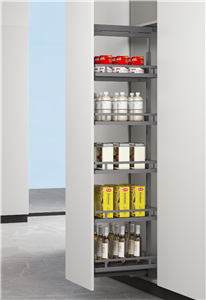
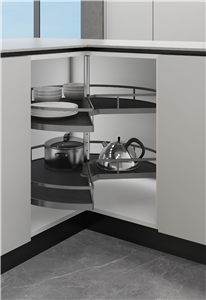
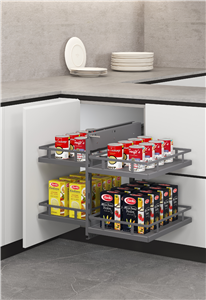
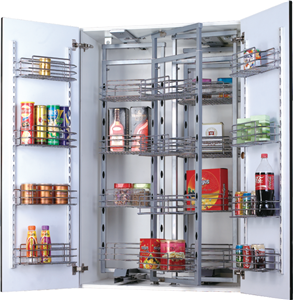
Pull-out storage rack shelves address these challenges through innovative engineering. Unlike fixed systems, these units feature:
- Full-extension drawer mechanisms that provide 100% access to contents
- Heavy-duty ball-bearing slides rated for 500-2,000 lbs capacity
- Modular design allowing customization for specific inventory types
- Safety locks preventing accidental extension under load
For space optimization, pull-out systems eliminate permanent aisles. The table below compares traditional versus pull-out configurations:
| Aspect | Traditional Shelving | Pull-Out Systems |
|---|---|---|
| Space Utilization | 50-60% effective use | 85-90% effective use |
| Aisle Requirements | Fixed, 4-6 feet wide | Dynamic, as needed |
| Access Time | Average 3-5 minutes/item | Average 1-2 minutes/item |
| Safety Rating | Basic compliance | Enhanced with locks/stops |
Foshan Meijiayi Hardware Company Limited specializes in manufacturing these systems using cold-rolled steel with powder-coated finishes, meeting ISO 9001:2015 quality standards. Their engineering team focuses on load distribution principles, ensuring each shelf maintains structural integrity while providing smooth mechanical operation.
Customer Success Stories
Case Study 1: Automotive Parts Distributor (Detroit, Michigan)
Great Lakes Auto Parts struggled with retrieving small components from deep shelving. After installing Meijiayi's pull-out systems:
- Storage density increased by 65% within the same footprint
- Retrieval time decreased from 4.2 to 1.8 minutes per item
- Worker compensation claims related to reaching injuries dropped by 40%
"We recovered 3,200 square feet of previously wasted space, allowing us to delay facility expansion by two years," noted Operations Manager David Chen.
Case Study 2: Pharmaceutical Warehouse (Hamburg, Germany)
EuroPharm Storage needed temperature-controlled access to sensitive medications. Meijiayi provided sealed pull-out units with:
- Integrated climate monitoring
- Antimicrobial coatings
- Sequential access tracking
Results included:
- 99.8% inventory accuracy (from 94.5%)
- 30% reduction in climate control energy usage
- Zero product spoilage incidents in 18 months
"The system pays for itself through reduced losses alone," stated Facility Director Anja Schmidt.
Case Study 3: Aerospace Manufacturing (Toulouse, France)
Aerospace Components Ltd. stored delicate instrumentation requiring careful handling. Their solution involved:
- Vibration-dampened pull-out shelves
- Electrostatic discharge protection
- Custom dividers for component separation
Key improvements:
- Assembly line stoppages decreased by 72%
- Component damage during retrieval eliminated
- Inventory counting time reduced from 8 hours to 90 minutes weekly
"Precision storage matches our precision manufacturing standards," commented Plant Manager Pierre Dubois.
Applications & Partnerships
Pull-out storage systems serve diverse applications:
- Manufacturing: Tool crib organization, spare parts management
- Logistics: Order picking optimization, returns processing
- Healthcare: Medical supply access, laboratory sample storage
- Retail: Backstock management, seasonal item rotation
Foshan Meijiayi partners with global distributors including Warehouse Solutions Inc. (North America), EuroStorage Systems (Europe), and Asia-Pacific Logistics Partners. These relationships ensure local technical support, spare parts availability, and customized implementation. The company maintains strategic alliances with material handling consultants and participates in industry standards committees to advance storage technology.
Frequently Asked Questions
Q1: What weight capacities can pull-out systems realistically handle in industrial settings?
A: Properly engineered systems support 800-2,000 lbs per shelf depending on configuration. Meijiayi's heavy-duty series uses 12-gauge steel construction with dual-track ball-bearing slides rated at 1,500 lbs dynamic/3,000 lbs static load. For specialized applications, custom solutions reach 5,000 lbs capacity using reinforced structures and hydraulic assist mechanisms.
Q2: How do pull-out systems integrate with warehouse management software (WMS)?
A: Modern systems feature RFID tags on each shelf or bin location. These interface with WMS through standard protocols (OPC UA, MQTT), providing real-time inventory tracking. Meijiayi's smart systems can even trigger replenishment orders when stock reaches minimum levels and optimize picking routes based on shelf extension patterns.
Q3: What maintenance is required for smooth long-term operation?
A: Quarterly inspection of slides and bearings, with annual lubrication using food-grade silicone spray for clean environments or industrial-grade lubricant for heavy-duty applications. Load testing should occur biannually. Most quality systems operate maintenance-free for 3-5 years before requiring component replacement, with slide mechanisms typically rated for 50,000-100,000 cycles.
Q4: Can these systems be retrofitted into existing rack structures?
A: Yes, approximately 70% of installations involve retrofitting. Critical considerations include existing upright frame strength, floor anchoring adequacy, and aisle width adjustments. Meijiayi provides engineering assessments measuring load capacity, seismic requirements (where applicable), and compatibility with current rack profiles (teardrop, structural, etc.).
Q5: What safety features prevent accidental collapse or injury?
A: Multiple integrated safeguards: positive locking mechanisms that engage automatically under load, progressive resistance that increases near full extension, visual overload indicators, and secondary retention pins. Systems exceeding 48" height include sequential release requiring deliberate action to access upper shelves, preventing simultaneous extension that could destabilize the unit.
Conclusion: Transforming Storage Intelligence
Pull-out storage rack shelves represent more than mere equipment—they embody a philosophy of intelligent space utilization. By addressing fundamental inefficiencies in access, density, and safety, these systems deliver measurable ROI through space recovery, productivity gains, and risk reduction. Foshan Meijiayi's engineering approach combines robust manufacturing with application-specific customization, ensuring solutions match operational realities.
For facility managers, engineers, and procurement specialists evaluating storage optimization, the question evolves from "Do we need better storage?" to "How quickly can we implement these improvements?" Download our detailed technical whitepaper covering load calculations, retrofit methodologies, and ROI analysis scenarios. For application-specific consultations, contact our sales engineering team who can assess your facility layout, inventory profile, and workflow patterns to recommend optimized configurations.