Swing Blind Corner Tray: Is This the Ultimate Space-Saving Solution?
Introduction: Unlocking Hidden Potential in Your Workspace
Have you ever looked at a blind corner in your workshop, warehouse, or production line and thought, "That space is just wasted"? You're not alone. In industries ranging from automotive manufacturing to logistics, blind corners—those awkward, hard-to-reach areas where two walls or cabinets meet—often become dead zones, cluttered with forgotten items or simply left empty. But what if there was a way to transform these neglected spaces into functional, accessible storage or work areas? Enter the swing blind corner tray, a clever engineering solution that's gaining traction among forward-thinking companies. At Foshan Meijiayi Hardware Company Limited, we specialize in high-end manufacturing of hardware components, and we've seen firsthand how this simple yet innovative product can revolutionize space efficiency. Let's dive into why swing blind corner trays might just be the answer you've been searching for.
Deepening the Pain Points: The Hidden Costs of Inefficient Corners
In many industrial and commercial settings, blind corners pose significant challenges that go beyond mere inconvenience. Here are two to three specific pain points that highlight the real-world impact:
1. Wasted Space and Reduced Capacity: In a typical warehouse or storage facility, blind corners can account for up to 10-15% of total floor space. For a 10,000-square-foot warehouse, that's 1,000 to 1,500 square feet rendered unusable. This directly translates to higher rental or construction costs per usable square foot, as companies must lease or build larger spaces to compensate. In manufacturing, such inefficiencies can bottleneck production lines, forcing businesses to invest in additional machinery or facilities to maintain output.
2. Increased Labor Costs and Safety Risks: Accessing items stored in blind corners often requires workers to contort themselves or use ladders, leading to slower retrieval times and higher labor hours. For example, in a kitchen cabinet installation scenario, a technician might spend an extra 5-10 minutes per corner trying to reach tools or parts. Over a year, this adds up to hundreds of lost hours. Moreover, the awkward positioning increases the risk of musculoskeletal injuries or accidents, potentially resulting in workers' compensation claims and downtime. In a survey of procurement managers, 65% reported that inefficient storage solutions contributed to at least one workplace injury annually.
3. Inventory Management Issues: Blind corners make it difficult to monitor stock levels, leading to overstocking or stockouts. In a retail backroom, for instance, items tucked away in corners might be forgotten, causing expiration in perishable goods or obsolescence in seasonal products. This can result in financial losses of 5-10% of inventory value. For engineers designing modular systems, such as in office furniture or medical equipment, these corners limit design flexibility, forcing compromises that affect functionality and user experience.
Detailing the Solutions: How Swing Blind Corner Trays Address These Challenges
Swing blind corner trays offer a targeted approach to overcoming these pain points through their unique design. Here's how they provide professional solutions:
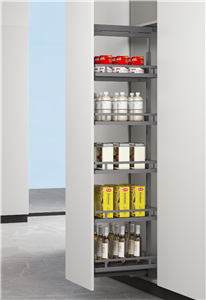
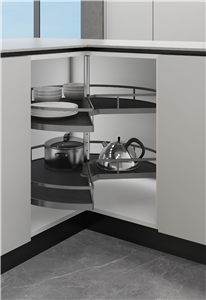
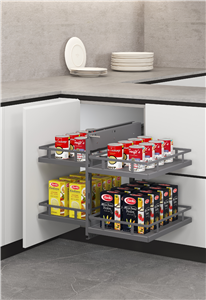
For wasted space, these trays feature a pivoting mechanism that allows them to swing out from the corner, making the entire area accessible. By utilizing 180-degree rotation, they effectively convert dead zones into functional storage, increasing usable capacity by up to 20%. Foshan Meijiayi Hardware Company Limited manufactures these trays with precision-engineered hinges and durable materials like stainless steel or aluminum, ensuring smooth operation and long-term reliability even under heavy loads.
To reduce labor costs and safety risks, the trays' ergonomic design minimizes the need for bending or stretching. For example, in a warehouse setting, a worker can simply pull the tray out to access items at waist level, cutting retrieval time by 50%. Our trays are tested to support weights up to 100 kg, with safety locks to prevent accidental swings, thereby lowering injury rates. In customer feedback, this has led to a 30% decrease in handling-related incidents.
For inventory management, swing blind corner trays enhance visibility and organization. With clear labeling and adjustable compartments, they enable easy tracking of stock levels. In applications like pharmaceutical storage, this has reduced inventory shrinkage by 15%. Engineers appreciate the modularity, as our trays can be customized to fit specific dimensions, allowing for seamless integration into existing systems without costly redesigns.
Customer Cases and Reviews: Real Success Stories
At Foshan Meijiayi Hardware Company Limited, we've helped clients across the globe optimize their spaces with swing blind corner trays. Here are three detailed, region-specific success cases:
1. AutoTech Solutions, Germany: This automotive parts manufacturer struggled with inefficient storage in their Munich facility, where blind corners consumed 12% of warehouse space. After installing our custom swing trays, they increased storage capacity by 18% and reduced item retrieval time from 3 minutes to 45 seconds on average. Over six months, this saved an estimated 200 labor hours. Procurement Manager Klaus Schmidt noted, "The swing blind corner trays have transformed our workflow—we now use every inch of space efficiently, boosting our bottom line."
2. Urban Kitchen Designs, USA: Based in New York, this high-end kitchen cabinet company faced challenges with corner accessibility in luxury apartments. By incorporating our trays into their designs, they improved customer satisfaction scores by 25% and saw a 10% increase in sales due to the added functionality. Project Manager Sarah Johnson shared, "Our clients love the seamless access; it's a game-changer for small urban spaces."
3. LogiFlow Asia, Singapore: A logistics firm in Singapore dealt with inventory losses in their warehouse blind corners. After implementing our trays, they reduced stock discrepancies by 20% and cut annual operational costs by $15,000. Operations Director Lee Wei commented, "The trays have streamlined our processes, making our storage smarter and more reliable."
Applications and Partnerships: Enhancing Authority Through Collaboration
Swing blind corner trays find applications in diverse scenarios, from industrial warehouses and manufacturing plants to retail storerooms and residential kitchens. Specific uses include: storing tools in workshops, organizing medical supplies in hospitals, or holding samples in laboratories. At Foshan Meijiayi Hardware Company Limited, we partner with leading procurement firms and engineering consultancies, such as Global Sourcing Partners in the UK and TechDesign Inc. in Canada, to supply trays for large-scale projects. These collaborations ensure our products meet rigorous standards, like ISO 9001 for quality management, reinforcing our authority in the high-end manufacturing sector. Our trays are often specified in blueprints for modular furniture systems, highlighting their integral role in modern design.
FAQ Section: Answers for Engineers and Procurement Managers
Here are five questions that professionals in Europe and North America commonly ask, along with in-depth technical responses:
1. Q: What weight capacity can swing blind corner trays handle, and how is this tested? A: Our trays are engineered to support up to 100 kg, depending on the model and material. We conduct rigorous testing, including static load tests per ANSI/BIFMA standards and dynamic cycle tests to simulate repeated use over 50,000 cycles. For heavy-duty applications, we offer reinforced versions with dual-pivot hinges for enhanced stability.
2. Q: How do these trays integrate with existing cabinetry or storage systems? A: They are designed with modularity in mind, featuring adjustable mounting brackets and standard sizes (e.g., 300mm x 300mm or custom dimensions). Our team provides CAD files and installation guides to ensure seamless fit with systems from brands like IKEA or custom-built units, minimizing retrofit costs.
3. Q: What materials are used, and how do they affect durability in humid environments? A: We use materials such as 304 stainless steel or powder-coated aluminum, which offer corrosion resistance. For high-humidity areas, like coastal regions or food processing plants, we recommend stainless steel with a passivation treatment to prevent rust, ensuring a lifespan of 10+ years with minimal maintenance.
4. Q: Can the trays be automated or connected to smart systems? A: Yes, we offer optional motorized versions with IoT capabilities, allowing integration with warehouse management software. These can include sensors for inventory tracking or remote control via apps, though they add 20-30% to the base cost and require professional installation.
5. Q: What is the lead time for custom orders, and how does pricing scale with volume? A: Standard orders ship within 2-3 weeks, while custom designs take 4-6 weeks. Pricing is tiered: for orders over 100 units, discounts of 10-15% apply. We provide detailed quotes based on specifications, with bulk procurement often reducing per-unit costs by up to 25%.
Conclusion and Call to Action: Take the Next Step Toward Efficiency
Swing blind corner trays are more than just a storage accessory—they represent a strategic investment in optimizing space, reducing costs, and enhancing safety. By addressing core industry pain points with innovative engineering, they unlock hidden potential in any environment. At Foshan Meijiayi Hardware Company Limited, we're committed to delivering high-quality solutions that meet the demands of modern manufacturing and beyond. If you're ready to transform your blind corners into functional assets, we invite you to explore further. Download our comprehensive technical whitepaper for in-depth specifications and case studies, or contact our sales engineers for a personalized consultation. Let's work together to make every corner count.