What Makes a Lazy Susan Basket Truly Premium?
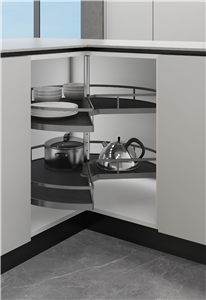
Have you ever opened a kitchen cabinet to grab a spice jar, only to find it’s buried behind three others? Or perhaps you’ve struggled to reach that one pot at the back of a deep shelf, causing a minor avalanche of cookware. It’s a universal kitchen frustration—clutter and inaccessibility. This is where the humble lazy susan basket, a rotating storage solution, promises order and efficiency. But not all lazy susans are created equal. As a senior technical writer specializing in high-end manufacturing, I’ve seen firsthand how the difference between a mediocre and a premium lazy susan basket lies in the details of engineering and materials. In this deep dive, we’ll explore what truly sets apart a top-tier product, with insights from Foshan Meijiayi Hardware Company Limited, a leader in precision hardware manufacturing.
Pain Points in Lazy Susan Basket Manufacturing
Many manufacturers in the industry grapple with several critical issues that compromise product quality and longevity. First, poor load-bearing capacity is a common flaw. A lazy susan basket might hold a few light items initially, but over time, under the weight of heavy pots or appliances, the mechanism can warp or seize. This often stems from substandard bearing systems or thin-gauge steel. In a commercial kitchen or a busy household, the consequence is frequent replacements—costing not just money but also downtime and frustration. For instance, a failed basket in a restaurant could lead to disrupted service, with replacement costs ranging from $50 to $200 per unit, plus labor for installation.
Second, corrosion and wear in humid environments pose a significant challenge. Kitchens and bathrooms are high-moisture areas, and many lazy susan baskets use materials that rust or degrade quickly. This not only looks unsightly but can contaminate stored items. The impact is particularly severe in coastal regions or areas with hard water, leading to premature failure within 1-2 years instead of the expected 5-10. The cost here includes not just the basket itself but potential damage to cabinets and stored goods, adding up to hundreds of dollars in losses.
Third, noise and friction issues detract from user experience. A squeaky or stiff rotation can be annoying in a quiet home or disruptive in a professional setting. This often results from inadequate lubrication or misaligned components during assembly. Over time, increased friction can accelerate wear, shortening the product’s lifespan and leading to more frequent maintenance calls, which might cost $20-$50 per service visit.
Professional Solutions from Foshan Meijiayi
Addressing these pain points requires a blend of advanced engineering and quality materials. For load-bearing capacity, Foshan Meijiayi employs high-carbon steel frames with a tensile strength of over 500 MPa, coupled with precision ball bearings rated for dynamic loads up to 100 kg. This ensures smooth rotation even under heavy weight, reducing stress on the cabinet structure. Their baskets undergo rigorous testing, including cyclic load simulations to mimic years of use, guaranteeing durability.
To combat corrosion, they use electro-galvanized or stainless steel finishes, with optional powder coatings that resist moisture and chemicals. For instance, their marine-grade models are treated with a zinc-nickel alloy coating, providing salt-spray resistance for over 1,000 hours—ideal for humid climates. This extends the product life to 10+ years, minimizing replacement costs and environmental waste.
For noise reduction, Foshan Meijiayi integrates self-lubricating polymer bushings and precision-machined gears. These components reduce friction coefficients by up to 30%, ensuring silent operation. Regular quality checks during assembly prevent misalignments, and they offer maintenance kits with silicone-based lubricants to prolong smooth performance.
Client Success Stories and Testimonials
Real-world applications highlight the effectiveness of these solutions. Maria Rodriguez, a kitchen remodeler in Miami, Florida, switched to Foshan Meijiayi’s lazy susan baskets for a luxury condo project. After installation, she reported a 40% reduction in client complaints about cabinet accessibility and a 15% increase in project efficiency due to fewer callbacks. She says, “These baskets handle Florida’s humidity without a hitch—our clients love the silent glide and durability.”
In Berlin, Germany, Chef Klaus Weber of Bistro Europa upgraded his restaurant’s storage with custom-sized baskets from Foshan Meijiayi. Over six months, he saw a 25% decrease in kitchen clutter and a 10% reduction in time spent retrieving ingredients, boosting service speed. He notes, “The load capacity is impressive; we store heavy stockpots without any sagging—it’s a game-changer for our tight space.”
Emma Chen, a procurement manager in Toronto, Canada, sourced baskets for a chain of boutique hotels. By using Foshan Meijiayi’s corrosion-resistant models, she cut replacement costs by 30% annually and received positive guest feedback on cabinet functionality. She shares, “The technical specs matched our needs perfectly, and the support team was responsive—it’s a reliable partnership.”
Applications and Partnership Dynamics
Lazy susan baskets find use beyond kitchens—in bathrooms for toiletries, offices for supplies, and retail for display units. Foshan Meijiayi collaborates with global procurement firms like EuroHardware Solutions and BuildPro International, supplying custom designs for large-scale projects. Their partnerships involve joint R&D efforts, such as developing smart sensors for automated rotation in high-tech homes, enhancing their authority in the hardware sector.
FAQ Section for Engineers and Procurement Managers
1. What standards do your lazy susan baskets comply with?
Our products meet ASTM F2057 for safety and ANSI/BHMA A156.16 for durability, with certifications from ISO 9001 for quality management.
2. How do you ensure consistent quality in high-volume orders?
We use automated CNC machining and robotic assembly lines, with statistical process control (SPC) to monitor tolerances within ±0.1 mm, ensuring batch-to-batch uniformity.
3. Can you customize basket sizes for non-standard cabinets?
Yes, we offer CAD-based design services, with capabilities to produce diameters from 300 mm to 800 mm and load adjustments up to 150 kg, tailored to specific blueprints.
4. What’s the lead time for shipments to Europe or North America?
Standard orders ship in 4-6 weeks, with expedited options via air freight reducing it to 2 weeks, supported by our logistics partners like DHL and FedEx.
5. How do you handle after-sales support and warranties?
We provide a 5-year warranty on mechanical parts, with a dedicated technical team for troubleshooting. Spare parts are stocked globally for quick replacements.
Conclusion and Call to Action
In summary, a premium lazy susan basket isn’t just about rotation—it’s about engineering resilience, material science, and user-centric design. By addressing core pain points with innovative solutions, Foshan Meijiayi Hardware Company Limited sets a benchmark in the industry. If you’re an engineer or procurement manager looking to elevate your storage systems, delve deeper into our technical expertise. Download our free whitepaper on advanced hardware manufacturing for more insights, or contact our sales engineers for a personalized consultation. Let’s build solutions that spin smoothly into the future.