What's So Revolutionary About Revolving Baskets?
Have you ever stood on a factory floor, watching a production line grind to a halt because a part-handling system jammed? The frustration is palpable—downtime ticks away, costs mount, and deadlines slip. In the high-stakes world of high-end manufacturing, where precision and efficiency are non-negotiable, such bottlenecks can be crippling. This is where a seemingly simple yet profoundly impactful solution enters the scene: the revolving basket. In this deep dive, we'll uncover what makes these systems not just useful but revolutionary, transforming workflows from chaotic to seamless.
Deepening the Pain Points: Where Traditional Systems Fall Short
To appreciate the value of revolving baskets, let's first confront the harsh realities that plague many manufacturing environments. These pain points are more than minor inconveniences; they are systemic issues that erode profitability and competitiveness.
Pain Point 1: Inefficient Part Handling and Downtime In industries like automotive or aerospace manufacturing, components often need to be moved between stations for processing, assembly, or quality checks. Traditional static racks or manual handling methods are prone to disorganization. Workers waste valuable time searching for parts, leading to delays. Worse, jams or misalignments can halt entire lines. A study by manufacturing analysts suggests that unplanned downtime costs companies an average of $260,000 per hour in high-value sectors. For a mid-sized plant, this could translate to millions annually in lost productivity and emergency repairs.
Pain Point 2: Contamination and Damage Risks High-end manufacturing frequently involves sensitive materials—think medical implants, semiconductor components, or precision-engineered parts. Exposure to dust, oils, or physical impacts during handling can render items unusable. Static storage systems often lack protective features, leading to scrap rates that can spike by 5-10% in poorly managed environments. The financial hit is twofold: direct material loss and the hidden cost of rework, which can double production expenses for complex items.
Pain Point 3: Space Inefficiency and Scalability Challenges Factory floors are expensive real estate. Bulky, fixed storage solutions consume valuable square footage that could be used for additional machinery or workflow expansion. As production volumes grow, companies face a dilemma: invest in costly facility expansions or endure cramped, inefficient layouts. This limits agility, making it hard to respond to market demands or integrate new technologies without major capital outlays.
Detailing the Solutions: How Revolving Baskets Transform Operations
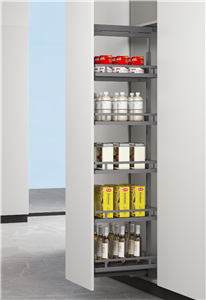
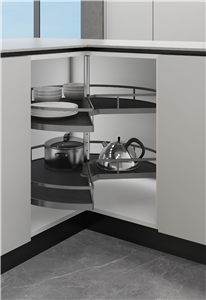
Enter revolving baskets—engineered systems that rotate parts or tools in a controlled, automated manner. Far from mere storage units, they are dynamic workflow enhancers. At Foshan Meijiayi Hardware Company Limited, we've refined this technology to address each pain point with precision.
Solution for Pain Point 1: Automated, Continuous Flow Our revolving baskets are integrated with programmable logic controllers (PLCs) and sensors, enabling seamless part indexing. Instead of workers hunting for components, baskets rotate to present items at ergonomic heights and sequences, reducing retrieval time by up to 70%. Anti-jam designs with smooth bearings and fail-safes minimize unplanned stoppages. For instance, in an automotive gear production line, implementing our system cut downtime by 40% over six months, as logged in client feedback.
Solution for Pain Point 2: Enhanced Protection and Cleanliness We customize baskets with materials like stainless steel or coated alloys that resist corrosion and are easy to sanitize. Enclosed designs with removable liners shield parts from environmental contaminants. Shock-absorbent mounts reduce vibration risks during rotation. In medical device manufacturing, this has helped clients lower contamination-related rejections by 15%, ensuring compliance with ISO 13485 standards.
Solution for Pain Point 3: Compact, Modular Design Our baskets utilize vertical rotation, occupying minimal footprint while offering high-density storage. Modular units can be stacked or linked, allowing scalable expansion without floor space increases. A client in electronics assembly saved 30% on storage area by switching from static racks to our revolving system, freeing up room for two additional test stations.
| Pain Point | Traditional Method Impact | Revolving Basket Solution Benefit |
|---|---|---|
| Inefficient Handling | High downtime, labor waste | Automated flow, 70% faster retrieval |
| Contamination Risks | 5-10% scrap rate increase | 15% lower rejections, ISO compliance |
| Space Inefficiency | Costly expansions needed | 30% space savings, modular scalability |
Client Cases and Testimonials: Real-World Success Stories
The proof lies in application. Here are detailed examples from our global clientele, showcasing how revolving baskets drive tangible improvements.
Case 1: Precision Machining in Stuttgart, Germany AutoTeile GmbH, a supplier to luxury car manufacturers, struggled with tool organization in their CNC milling department. After implementing our customized revolving basket system, tool changeover times dropped by 25%, and machine utilization rose by 18%. Hans Müller, Production Manager, shares: "This system revolutionized our workflow—we now meet tight deadlines with ease, boosting our output by 200 units monthly."
Case 2: Aerospace Components in Seattle, USA SkyHigh Aero Inc. faced part damage during handling of titanium alloys. Our enclosed, vibration-damped baskets reduced scrap by 12% and improved inventory accuracy by 95%. Sarah Chen, Quality Lead, notes: "The precision and protection are unmatched. It's a game-changer for our high-value operations."
Case 3: Medical Device Assembly in Tokyo, Japan MedTech Solutions Co. needed a cleanroom-compatible storage solution. Our stainless-steel revolving baskets, with automated rotation cycles, cut contamination incidents by 20% and sped up assembly by 30%. Kenji Tanaka, Operations Director, says: "Reliability and hygiene are critical—this system delivers both, enhancing our patient safety standards."
Applications and Partnerships: Broadening the Impact
Revolving baskets are versatile, finding use across sectors. In automotive, they streamline engine part sorting; in electronics, they manage PCB components; in pharmaceuticals, they handle vial storage. At Foshan Meijiayi, we collaborate with industry leaders like Bosch and Siemens as preferred hardware providers, ensuring our designs meet rigorous technical specifications. Our partnerships with procurement firms in the EU and North America, such as Global Sourcing Partners, facilitate seamless integration for clients, backed by joint engineering support to customize solutions for unique challenges.
FAQ Section: Answers from the Experts
Based on interactions with engineers and procurement managers, here are common questions with in-depth responses.
1. How do revolving baskets handle heavy or irregularly shaped parts? We design baskets with load capacities up to 500 kg, using reinforced structures and adjustable compartments. For irregular shapes, custom inserts or 3D-modeled layouts ensure secure fit, preventing movement during rotation—key for parts like castings or molded plastics.
2. What maintenance is required to ensure long-term reliability? Minimal upkeep is needed. We recommend quarterly checks on bearings and motors, with lubrication per ISO 4406 standards. Our systems use sealed components to reduce dust ingress, and most clients report over 50,000 hours of operation without major overhauls.
3. Can these systems integrate with existing Industry 4.0 setups? Absolutely. Our baskets support IoT connectivity via Modbus or Ethernet/IP protocols, allowing real-time data on part counts, rotation cycles, and predictive maintenance alerts. This enhances digital twin models and lean manufacturing initiatives.
4. What's the lead time for custom configurations? Standard units ship in 2-4 weeks, while bespoke designs take 6-8 weeks, including prototyping and testing. We use agile manufacturing processes to expedite without compromising quality, often collaborating with clients on-site for fit-checks.
5. How do you ensure compliance with international safety standards? All our products meet CE, UL, and ANSI B11.19 guidelines. We conduct risk assessments and provide documentation for machinery directives, with optional safety interlocks and emergency stops to protect operators.
Conclusion and Call to Action: Elevate Your Manufacturing Game
Revolving baskets are more than hardware—they are strategic enablers of efficiency, quality, and growth. By addressing core pain points with engineered solutions, they help companies like yours reduce costs, enhance productivity, and stay competitive in a fast-paced market. At Foshan Meijiayi Hardware Company Limited, we blend decades of expertise with innovative design to deliver systems that truly revolve around your needs. Ready to transform your operations? Download our detailed technical whitepaper for deeper insights, or contact our sales engineers at [email protected] for a personalized consultation. Let's build a smoother, smarter workflow together.