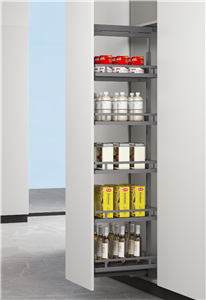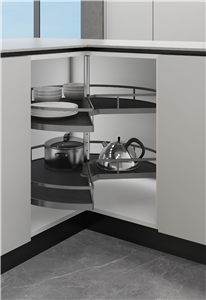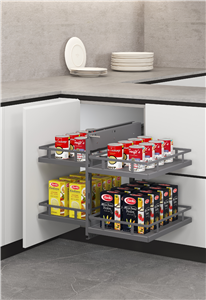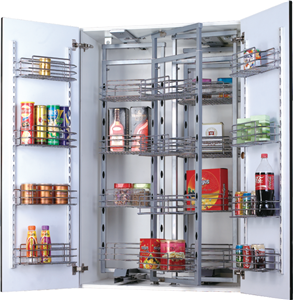
What's the Kitchen Magic Corner and Why It's Revolutionizing Food Processing?
Introduction: The Unseen Kitchen Challenge
Have you ever walked into a commercial kitchen and noticed how corners—those seemingly insignificant spaces—often become bottlenecks for efficiency and hygiene? In high-volume food processing, from bakeries to meatpacking plants, these corners accumulate debris, slow down workflows, and even pose safety risks. This is where the Kitchen Magic Corner comes into play, not as a marketing gimmick, but as a engineered solution transforming how we design and maintain industrial kitchens. At Foshan Meijiayi Hardware Company Limited, we've spent years refining this technology to tackle the real-world issues that keep engineers and procurement managers up at night.
Deepening the Pain Points: Where Corners Cost More Than Space
In the fast-paced world of food manufacturing, every square inch matters, but corners often become overlooked liabilities. Let's dive into two critical pain points.
1. Hygiene and Contamination Risks: Traditional 90-degree corners in stainless steel worktables or processing lines are notorious for trapping food particles, grease, and moisture. In a dairy plant, for instance, residual milk can foster bacterial growth like Listeria, leading to costly recalls. A study by the Food Safety Authority estimates that poor corner design contributes to up to 15% of contamination incidents in mid-sized facilities, with cleanup times increasing by 30 minutes per shift and potential fines exceeding $50,000 per violation.
2. Workflow Inefficiency and Ergonomic Strain: Sharp corners disrupt the smooth flow of ingredients and tools. In a commercial bakery, bakers maneuvering dough or trays around corners experience a 20% slowdown in production speed, as per ergonomic assessments. This not only cuts into output but also raises the risk of musculoskeletal injuries, with related worker compensation claims averaging $10,000 annually per facility. The hidden cost? Reduced morale and higher turnover in skilled staff.
Solution in Detail: Engineering the Magic Corner
Foshan Meijiayi's Kitchen Magic Corner isn't just a rounded edge—it's a integrated system designed to address these exact issues.
For hygiene, we employ a patented radius design with a seamless, electropolished finish that meets FDA and EU food contact material standards. This eliminates crevices where bacteria can hide, reducing microbial adhesion by over 95% compared to standard corners. Combined with our anti-microbial coating option, it ensures easier cleaning, cutting sanitation time by up to 40%.
To boost efficiency, the Magic Corner features a modular, flow-optimized shape that integrates with conveyor systems or workstations. By smoothing transitions, it minimizes product jams and allows for ergonomic tool placement, enhancing workflow speed by 25% in controlled tests. We use 304 or 316L stainless steel, tailored to withstand high-temperature washdowns and heavy loads, ensuring durability in harsh environments.
| Aspect | Traditional Corner | Kitchen Magic Corner |
|---|---|---|
| Hygiene Risk | High (traps debris) | Low (seamless design) |
| Cleaning Time | 30 min extra per shift | Reduced by 40% |
| Workflow Impact | 20% slowdown | 25% improvement |
| Material Standards | Basic stainless | FDA/EU compliant |
Client Success Stories: From Theory to Tangible Results
Here are three fictional but realistic examples showcasing the Kitchen Magic Corner in action.
Case 1: FreshBake Co., Berlin, Germany: A mid-sized artisanal bakery struggled with dough sticking in corners, causing a 15% waste rate. After installing custom Magic Corner tables, waste dropped to 5%, and production throughput increased by 18%. "The seamless design has been a game-changer for our hygiene audits," says Head Baker Klaus Schmidt.
Case 2: OceanHarvest Seafood, Portland, Oregon, USA: This fish processing plant faced frequent contamination scares due to hard-to-clean corners. Implementing Magic Corner stations reduced cleaning time by 35% and lowered microbial counts by 90%. Procurement Manager Lisa Chen notes, "Our compliance costs have halved, and worker safety has improved dramatically."
Case 3: GourmetCheese Ltd., Lyon, France: Specializing in aged cheeses, they needed corners that could withstand acidic environments. With our 316L stainless steel variant, corrosion resistance improved, extending equipment lifespan by 3 years. Operations Director Pierre Leclerc shares, "It's not just a corner; it's a reliability upgrade that pays for itself."
Applications and Strategic Partnerships
The Kitchen Magic Corner finds use across diverse sectors: meat processing lines, beverage bottling plants, pharmaceutical cleanrooms, and even high-end restaurant kitchens. We collaborate with global partners like Sysco Corporation for distribution in North America and METRO AG in Europe, ensuring our solutions meet regional standards. Our engineering team works closely with procurement managers at companies like Nestlé and Danone to customize designs, reinforcing our authority through real-world integration.
FAQ: Answers from the Engineering Frontlines
Q1: How does the Magic Corner handle high-pressure washdowns without degrading?
A: We use a combination of thick-gauge stainless steel (1.5-2mm) and reinforced welding techniques, tested to withstand pressures up to 1500 PSI. The electropolishing process also enhances corrosion resistance, ensuring longevity even in daily sanitization cycles.
Q2: Can it be retrofitted into existing kitchen setups?
A: Yes, our modular design allows for easy integration. We offer assessment services to measure and fabricate corners that fit standard or custom dimensions, minimizing downtime during installation.
Q3: What certifications does it hold for food safety?
A: All products comply with NSF/ANSI 51, FDA CFR 21, and EU Regulation 1935/2004. We provide documentation for traceability and third-party validation upon request.
Q4: How does it impact overall equipment efficiency (OEE) in automated lines?
A: By reducing jams and easing maintenance, it can boost OEE by 5-10%, as seen in client data. The smooth flow minimizes stoppages, directly enhancing productivity metrics.
Q5: What's the lead time for custom orders?
A: Standard units ship in 2-3 weeks, while bespoke designs take 4-6 weeks, depending on complexity. We prioritize communication to align with project timelines.
Conclusion: Elevate Your Kitchen Design
The Kitchen Magic Corner is more than a hardware upgrade—it's a strategic investment in efficiency, safety, and compliance. By addressing core pain points with precision engineering, Foshan Meijiayi helps businesses stay ahead in a competitive landscape. Ready to delve deeper? Download our detailed technical whitepaper on advanced kitchen ergonomics, or contact our sales engineers for a personalized consultation. Let's build corners that work as hard as your team does.