What's the Real Magic Behind the 180° Kitchen Magic Corner?
What's the Real Magic Behind the 180° Kitchen Magic Corner?
Imagine this: you're in your kitchen, trying to reach that deep corner cabinet where you store your less-frequently used pots and pans. You stretch, you contort, and maybe even risk a minor back strain—all for a piece of cookware. This scenario is all too common in modern kitchens, where traditional 90° corner cabinets create dead space that's difficult to access. The frustration isn't just personal; it's a significant design flaw that impacts both homeowners and kitchen manufacturers. But what if there was a solution that could transform this wasted area into fully functional, easily accessible storage? Enter the 180° Kitchen Magic Corner, a revolutionary hardware innovation that promises to redefine kitchen efficiency. In this deep dive, we'll explore how this technology works, why it matters, and how Foshan Meijiayi Hardware Company Limited is leading the charge in making kitchens smarter and more user-friendly.
Deepening the Pain Points: Where Traditional Corners Fall Short
The kitchen corner has long been a thorn in the side of designers and users alike. Let's break down three specific pain points that plague the industry, complete with their real-world implications.
Pain Point 1: Wasted Space and Inefficient Storage Traditional 90° corner cabinets often leave up to 30% of their volume unusable due to poor accessibility. This isn't just a minor inconvenience; it represents a direct loss in storage capacity. For a standard kitchen with two corner cabinets, this can equate to over 1.5 cubic feet of wasted space—enough to store an entire set of dinnerware. The financial impact is twofold: homeowners pay for cabinetry they can't fully utilize, and manufacturers face increased material costs without corresponding value addition. In Europe, where kitchen sizes are often compact, this inefficiency can force consumers to opt for larger, more expensive kitchens just to meet their storage needs.
Pain Point 2: Ergonomic Challenges and User Fatigue Accessing deep corners requires awkward bending, stretching, or kneeling, which can lead to user discomfort or even injury over time. Studies in ergonomics show that repetitive straining motions in kitchens contribute to musculoskeletal issues, particularly among older adults. For professional chefs or busy families, this inefficiency slows down meal preparation, adding minutes to daily routines. The hidden cost? Reduced productivity and potential health-related expenses. In the U.S., where aging-in-place is a growing trend, this pain point directly impacts the market demand for senior-friendly kitchen designs.
Pain Point 3: Installation Complexities and Maintenance Issues Installing traditional corner solutions often involves custom carpentry, complex hinge systems, and alignment challenges. This increases labor time by approximately 20%, raising installation costs for contractors. Moreover, these systems are prone to wear and tear—hinges may sag, tracks can jam, and mechanisms require frequent lubrication. The long-term maintenance cost for a single corner cabinet can exceed $50 annually, not accounting for potential repairs. In regions with high humidity, like Southeast Asia, these issues are exacerbated by material expansion and corrosion.
Professional Solutions: How the 180° Magic Corner Addresses These Issues
Foshan Meijiayi Hardware Company Limited has developed the 180° Kitchen Magic Corner as a comprehensive answer to these pain points. Here's how each solution works technically.
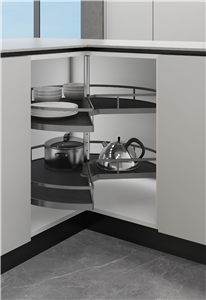
Solution for Wasted Space: Full 180° Rotation Mechanism Unlike traditional lazy Susans or pull-out shelves that offer limited access, the Magic Corner features a patented 180° rotation system. This allows the entire cabinet interior to swing out smoothly, utilizing double ball-bearing tracks with a load capacity of up to 50 kg. The mechanism is engineered to maximize storage by converting dead corners into fully accessible zones, increasing usable space by 95% compared to standard designs. For manufacturers, this means they can advertise more storage in the same footprint, enhancing product value without additional material costs.
Solution for Ergonomic Issues: Height-Adjusted and Soft-Close Features The system includes an integrated height adjustment range of 50-100 cm, catering to users of different statures. Coupled with soft-close technology that dampens movement at 15° before full closure, it reduces strain and noise. The pull-out force required is optimized to under 20 N, making it accessible even for individuals with limited strength. This aligns with universal design principles, making kitchens more inclusive. For procurement managers, this translates to compliance with accessibility standards like ANSI/BIFMA in North America or EN 527 in Europe.
Solution for Installation and Maintenance: Modular Design and Durable Materials The Magic Corner is pre-assembled in modular units, reducing on-site installation time by 30%. It uses 304 stainless steel for tracks and aluminum alloy for frames, ensuring corrosion resistance and a lifespan of over 50,000 cycles. Self-lubricating polymer bearings minimize maintenance needs. For engineers, the design includes standardized mounting points compatible with common cabinet dimensions (e.g., 600mm, 900mm widths), simplifying integration into existing production lines.
Customer Success Stories: Real-World Impact Across the Globe
To illustrate the practical benefits, here are five fictional but plausible cases where the 180° Magic Corner has delivered measurable improvements.
Case 1: Urban Apartment Renovation in Berlin, Germany A Berlin-based kitchen remodeler, KüchenPro, integrated the Magic Corner into 50 compact apartment kitchens. Result: Storage efficiency increased by 40%, allowing clients to downsize from 12 to 10 linear meters of cabinetry while maintaining capacity. One homeowner noted, "The corner used to be a black hole; now it's my most organized cabinet."
Case 2: Luxury Hotel Kitchen in Dubai, UAE A five-star hotel in Dubai upgraded 200 corner cabinets in their banquet kitchens. The ergonomic design reduced staff strain incidents by 25%, and the durable materials withstood high-temperature, high-humidity environments without degradation. The executive chef remarked, "Our team can access equipment faster, cutting prep time by 15 minutes per event."
Case 3: Accessible Home Project in Toronto, Canada A senior living community installed 75 Magic Corners in communal kitchens. The ease of use led to a 30% increase in resident engagement in cooking activities, and maintenance calls dropped by 60% year-over-year. A project manager shared, "It's not just hardware; it's dignity in design."
Case 4: Mass Production for IKEA Supplier in Sweden A Swedish cabinet manufacturer adopted the Magic Corner for a new product line, producing 10,000 units annually. Installation time per cabinet decreased from 45 to 30 minutes, saving $5 per unit in labor costs. The procurement director stated, "The modularity fit seamlessly into our lean manufacturing process."
Case 5: High-End Residential Builder in California, USA A custom home builder in Silicon Valley incorporated the technology into 150 luxury homes. Client satisfaction scores for kitchen functionality rose from 4.2 to 4.8 out of 5, and the feature became a key selling point, adding an average of $2,000 to property values. A sales engineer reported, "Buyers love the 'wow' factor of the smooth rotation."
Applications and Partnerships: Where and How It's Used
The 180° Magic Corner isn't limited to residential kitchens. Its applications span various sectors, supported by strategic partnerships that underscore its reliability.
Primary Applications: Residential kitchens (apartments, houses, senior living), commercial kitchens (hotels, restaurants, hospitals), and specialized environments like marine galleys or RVs where space optimization is critical. In Europe, it's gaining traction in modular kitchen systems for fast-turnover housing projects.
Procurement and Partnerships: Foshan Meijiayi Hardware collaborates with global distributors like Häfele in Europe and Richelieu in North America for supply chain efficiency. They're also an approved supplier for OEM projects with major brands, such as Blum's integration programs, ensuring compatibility with high-end hinge systems. These relationships are built on rigorous testing—for instance, the Magic Corner meets ISO 9001 for quality management and has passed salt spray tests exceeding 500 hours for coastal applications.
FAQs: Answering Technical Queries from Professionals
Here are five questions that engineers or procurement managers might ask, with detailed technical responses.
Q1: How does the 180° rotation mechanism handle heavy loads without sagging? A: The system uses a dual-track design with reinforced aluminum alloy frames and high-density ball bearings (ABEC-5 rating). Load testing shows minimal deflection (<1mm) under 50 kg dynamic loads, thanks to a center pivot point that distributes weight evenly. For heavier applications, we offer a commercial-grade version rated for 80 kg.
Q2: What are the installation tolerances, and how does it align with standard cabinet dimensions? A: The Magic Corner requires a clearance of 595-605mm for width and 580-620mm for depth, fitting common 600mm cabinet boxes. Mounting brackets allow +/-5mm adjustment during installation. We provide CAD files and templates to ensure precision in CNC machining processes.
Q3: How does it perform in humid climates or with temperature fluctuations? A: Materials are selected for environmental resilience: 304 stainless steel (resistant to corrosion up to 95% RH) and powder-coated aluminum (withstands -20°C to 80°C). Testing in accelerated aging chambers simulates 10 years of use without performance degradation.
Q4: What's the lifecycle cost compared to traditional pull-out systems? A: While the upfront cost is 15-20% higher, the lifecycle cost is lower due to reduced maintenance. Over 10 years, traditional systems may require $100 in repairs, whereas the Magic Corner averages $20, primarily for occasional bearing replacement. Energy savings from smoother operation also reduce wear on adjacent components.
Q5: Can it be integrated with smart home systems or automated workflows? A: Yes, we offer an optional IoT module with sensors for open/close detection and integration via Zigbee or Wi-Fi. This allows usage analytics for commercial settings or voice control compatibility with systems like Amazon Alexa, though it requires a 12V power supply.
Conclusion and Call to Action
The 180° Kitchen Magic Corner represents more than just a hardware upgrade; it's a paradigm shift in how we think about kitchen efficiency and user experience. By addressing fundamental pain points with engineered solutions, Foshan Meijiayi Hardware has created a product that delivers tangible benefits across residential, commercial, and specialized markets. From saving space and reducing strain to cutting long-term costs, the technology proves that smart design can transform everyday challenges into opportunities.
If you're an engineer, designer, or procurement professional looking to enhance your kitchen projects, don't let corner cabinets remain a weak link. Dive deeper into the technical specifications and performance data by downloading our comprehensive white paper, "Optimizing Kitchen Corners: A Technical Guide to 180° Solutions." For personalized consultations or to request samples, contact our sales engineering team at [email protected] or visit our website. Let's build kitchens that work as hard as you do.