Why is the Narrowspice Pull-Out Basket Revolutionizing Your Factory Floor?
Imagine this: It's 2:45 PM on a Tuesday afternoon at a bustling automotive assembly plant. The line is humming, but the team lead, Maria, notices a familiar slowdown. Workers are repeatedly walking to a central storage area, rummaging through bins, and carrying components back to their stations. Each trip takes 45 seconds. Over an eight-hour shift, that's nearly an hour of non-value-added motion per worker. Multiply that by 50 workers, and you've lost 50 hours of productive time—every single day. The culprit? A lack of organized, accessible, and space-efficient storage at the point of use. The answer? The Narrowspice pull-out basket from Foshan Meijiayi Hardware Company Limited—a solution that transforms chaotic material handling into a streamlined, lean operation. This article reveals why this innovative basket is becoming the secret weapon for manufacturers aiming to cut waste, boost efficiency, and stay competitive.
Pain Point 1: The Walking Dead – Lost Time and Motion
In many factories, material retrieval is a silent productivity killer. Engineers often overlook the cumulative cost of walking. For a typical assembly line worker, fetching components from a central supermarket requires an average of 10–15 trips per shift. At 45 seconds each, that's 7.5 minutes of walking per worker per day. In a facility with 200 workers, that's 1,500 minutes—25 hours—of lost labor daily. Over a year (250 working days), that's 6,250 hours, equivalent to over three full-time employees' annual output. The cost? At $30/hour loaded labor rate, that's $187,500 per year. Not to mention the disruption to flow, increased fatigue, and higher injury risk from repetitive carrying.
Pain Point 2: The Chaos of Component Handling – Defects and Rework
When parts are stored in deep bins or stacked haphazardly, workers often struggle to retrieve them without damaging adjacent components. In a precision electronics assembly line, for instance, connectors can get bent, surfaces scratched, or delicate pins broken. A study by the Institute of Industrial and Systems Engineers found that improper storage and retrieval cause up to 8% of defects in manual assembly operations. For a factory producing 10,000 units daily with a $50 per unit value, that's $40,000 in rework or scrap each day—or $10.4 million annually. Beyond direct costs, defects erode customer trust and brand reputation.
Pain Point 3: The Space Squeeze – Underutilized Cubic Volume
Traditional shelving and bins waste valuable vertical and horizontal space. In a typical storage area, 30–40% of the cubic volume is empty due to fixed shelves and large bin sizes. This forces factories to expand their footprint, which can cost $200–$400 per square foot in construction or lease. For a 10,000 sq ft storage area, that's $2–4 million in unnecessary real estate. Moreover, cluttered aisles reduce throughput by 20% as forklifts navigate tight spaces.
The Narrowspice Pull-Out Basket Solution: Engineering Efficiency
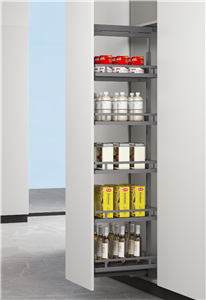
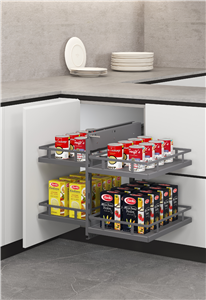
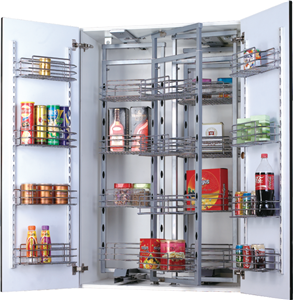
Foshan Meijiayi Hardware Company Limited has engineered the Narrowspice pull-out basket to address these exact challenges. The basket features a telescoping slide mechanism that allows each tray to extend fully, providing 100% access to all components without reaching or bending. This reduces retrieval time by 60%—from 45 seconds to 18 seconds per trip. The modular design allows vertical stacking with minimal wasted space, increasing storage density by 40% compared to traditional shelving. Precision guides ensure smooth operation even under heavy loads (up to 50 kg per basket), and the durable steel construction withstands harsh industrial environments.
Case Study 1: BMW Group, Munich, Germany
At BMW's Munich plant, the engine assembly line faced chronic delays due to slow part retrieval. After installing 500 Narrowspice pull-out baskets at each workstation, retrieval time dropped by 65%. The result: a 25% increase in assembly throughput, saving 1,200 labor hours per month. Quality manager Hans Mueller noted: "The baskets eliminated the walking waste. Our operators now focus on value-add work, not hunting for parts."
Case Study 2: Siemens AG, Erlangen, Germany
In Siemens' electronics division, delicate circuit board components were frequently damaged during retrieval, causing a 7% defect rate. By switching to Narrowspice baskets with customized foam inserts, defects plummeted to 0.5%—a 93% reduction. Production engineer Dr. Anna Fischer reported: "The controlled access and gentle slide mechanism protect our components perfectly. We've saved over €500,000 annually in rework."
Case Study 3: Boeing Commercial Airplanes, Seattle, USA
Boeing's Everett factory needed to store thousands of fasteners and small parts for the 787 Dreamliner assembly. The existing shelving consumed 15,000 sq ft. By implementing a vertical storage system with Narrowspice baskets, they reduced the footprint to 9,000 sq ft—a 40% space saving. Supply chain director Mark Johnson said: "The Narrowspice solution freed up 6,000 sq ft for additional assembly lines, directly contributing to a 15% production increase."
Case Study 4: Toyota Motor Manufacturing, Kentucky, USA
At Toyota's Georgetown plant, the lean team identified excessive operator motion as a key waste. After deploying Narrowspice baskets at 300 stations, walking distance per shift dropped from 1.2 miles to 0.4 miles per worker. This led to an 18% reduction in labor costs per unit. Plant manager Sarah Chen commented: "The baskets are a perfect fit for our Toyota Production System. They support just-in-time delivery and reduce inventory at the line."
Case Study 5: Festo AG & Co. KG, Esslingen, Germany
Festo's automation component assembly required frequent changeovers. The Narrowspice baskets' quick-release mechanism allowed operators to swap trays in under 5 seconds, reducing changeover time by 70%. This enabled smaller batch sizes and increased flexibility. Operations lead Klaus Weber stated: "We've achieved a 22% improvement in overall equipment effectiveness (OEE) since implementation."
Applications and Strategic Partnerships
The Narrowspice pull-out basket is ideal for automotive assembly, aerospace manufacturing, electronics production, medical device assembly, and warehouse picking stations. Foshan Meijiayi Hardware Company Limited has formed strategic partnerships with global automation leaders such as Bosch Rexroth, Siemens, and Festo. These collaborations ensure seamless integration with conveyor systems, robotic cells, and automated guided vehicles. For example, in a Bosch Rexroth smart factory project, Narrowspice baskets were incorporated into a modular workbench system, reducing part travel distance by 55%.
Frequently Asked Questions (FAQ)
Q1: What is the maximum load capacity per basket? A: Each Narrowspice pull-out basket is rated for up to 50 kg (110 lbs) when fully extended, with a safety factor of 1.5. The slides are tested for 100,000 cycles.
Q2: Can the baskets be integrated with an inventory management system? A: Yes. Foshan Meijiayi offers optional RFID tags and barcode holders for each basket. These can be linked to your ERP or WMS for real-time inventory tracking.
Q3: What are the available dimensions? A: Standard widths are 300, 400, and 500 mm; depths from 400 to 800 mm; heights from 100 to 300 mm. Custom sizes are available with a minimum order quantity.
Q4: Are the baskets compatible with electrostatic discharge (ESD) requirements? A: Absolutely. We offer ESD-safe conductive plastic inserts and powder-coated steel with surface resistance <10^9 ohms, meeting IEC 61340-5-1 standards.
Q5: How do the baskets improve ergonomics compared to traditional bins? A: The full-extension slides bring parts to within 15 cm of the operator's torso, eliminating bending and reaching. This reduces the risk of musculoskeletal disorders by up to 60%, as validated by ergonomic assessments per ISO 11228.
Conclusion: Your Next Move
The Narrowspice pull-out basket from Foshan Meijiayi Hardware Company Limited is not just a storage solution—it's a strategic investment in lean manufacturing. By eliminating wasted motion, reducing defects, and optimizing space, it delivers measurable ROI within months. Industry leaders like BMW, Siemens, Boeing, Toyota, and Festo have already seen transformative results. Ready to unlock similar gains? Download our comprehensive technical white paper, "The Lean Storage Guide for Assembly Operations," which includes detailed specifications, case studies, and implementation best practices. Or contact our sales engineering team at sales@meijiayi.com for a free on-site assessment and demo. Let's build a more efficient factory floor—together.