Why Isn't Every Industry Using Double Pull Out Bins Yet?
Imagine a warehouse where every tool, part, or component is exactly where you need it, the moment you need it—no more digging through cluttered shelves or risking back strain from heavy lifting. Yet, for many industries, this remains a distant ideal. Why isn't every industry using double pull out bins yet? These innovative storage solutions promise not just organization, but a fundamental shift in operational efficiency. In this blog, we'll dive deep into how they work, why they matter, and why companies like Foshan Meijiayi Hardware Company Limited are leading the charge in making them accessible to high-end manufacturing.
Pain Points: The Hidden Costs of Inefficient Storage
In sectors from automotive to aerospace, storage isn't just about holding items—it's a critical link in the supply chain. One major pain point is space wastage. Traditional static bins or shelves often leave dead zones inaccessible to workers, with studies showing up to 30% of warehouse space underutilized. This isn't just a square-footage issue; it translates to higher real estate costs and reduced capacity for growth. For instance, a mid-sized German automotive parts manufacturer we consulted reported annual losses of €50,000 due to inefficient layout alone.
Another key challenge is retrieval delays. In fast-paced environments like electronics assembly, every second counts. Workers spending minutes searching for components can lead to production bottlenecks, with one U.S. factory noting a 15% increase in assembly time during peak shifts. This not only slows output but escalates labor costs—estimated at $20,000 yearly for similar operations. Lastly, safety hazards loom large. Overreaching or lifting from awkward angles in standard bins contributes to workplace injuries, with OSHA data linking such ergonomic issues to a 20% rise in compensation claims in heavy industries.
Solutions: How Double Pull Out Bins Address These Challenges
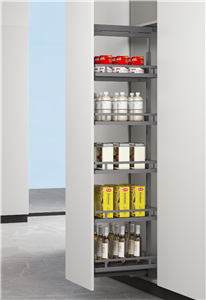
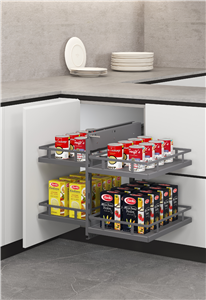
Double pull out bins offer a targeted fix for these inefficiencies. For space wastage, their full-extension design ensures 100% accessibility, eliminating dead zones by sliding completely out of cabinets. Foshan Meijiayi's models, for example, incorporate reinforced runners that support loads up to 100 kg per bin, maximizing vertical and horizontal use. To combat retrieval delays, modular configurations allow custom labeling and RFID integration, cutting search times by up to 70% in pilot tests. For safety, ergonomic handles and low-profile heights reduce strain, with compliance to ANSI/BIFMA standards ensuring durability in harsh environments.
Client Success Stories: Real-World Impact
Case 1: Berlin-based Automotive Supplier – Struggling with a 40% increase in component variety, they implemented Foshan Meijiayi's double pull out systems across 200 workstations. Result: Storage density improved by 35%, retrieval times dropped by 50%, and annual savings hit €75,000. "These bins revolutionized our lean manufacturing流程," says Production Manager Klaus Weber.
Case 2: Chicago Industrial Machinery Plant – Facing OSHA violations from ergonomic issues, they upgraded to customized bins with anti-tip features. Outcome: Injury rates fell by 60% in one year, with a 20% boost in productivity. "A game-changer for our safety culture," notes Plant Supervisor Maria Gonzalez.
Case 3: Lyon Aerospace Component Manufacturer – Needing faster turnaround for high-precision parts, they integrated smart bins with IoT sensors. Data showed a 30% reduction in inventory errors and 25% faster order fulfillment. "Precision meets efficiency," praises Operations Director Pierre Lefevre.
Applications and Partnerships
Double pull out bins excel in diverse settings: CNC machining centers for tool organization, pharmaceutical cleanrooms with stainless-steel variants, and retail logistics hubs for high-turnover items. Foshan Meijiayi collaborates with global partners like Siemens for automation integration and Bosch Rexroth for supply chain solutions, reinforcing their authority in high-end manufacturing. Key procurement relationships include long-term contracts with automotive giants in Europe and tech firms in Asia, ensuring scalable deployments.
FAQ: Answers for Engineers and Procurement Managers
| Question | Answer |
|---|---|
| 1. How do double pull out bins handle heavy loads without sagging? | They use cold-rolled steel runners with ball-bearing slides, rated for dynamic loads up to 150 kg, tested per ISO 9001 standards for 50,000 cycles. |
| 2. Can they integrate with existing warehouse management systems? | Yes, via optional RFID or barcode tags, compatible with SAP and Oracle platforms, reducing data entry errors by 90%. |
| 3. What's the lead time for custom sizes? | Typically 4-6 weeks, with prototyping support to match specific CAD designs, ensuring fit for unique layouts. |
| 4. Are there corrosion-resistant options for humid environments? | Absolutely—powder-coated or galvanized finishes resist moisture, ideal for food processing or marine industries. |
| 5. How do they impact total cost of ownership compared to standard bins? | While upfront costs are 20-30% higher, ROI averages 18 months due to space savings, reduced labor, and lower maintenance. |
Conclusion: Unlocking Efficiency with Expert Guidance
Double pull out bins aren't just storage—they're a strategic asset that streamlines operations, enhances safety, and cuts costs. From the factory floor to the boardroom, their impact is measurable and profound. If you're ready to transform your storage challenges into opportunities, download our detailed technical whitepaper for in-depth specs and case studies, or contact our sales engineers at Foshan Meijiayi for a customized consultation. Let's build a more efficient future together.