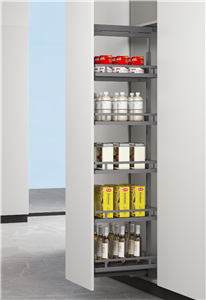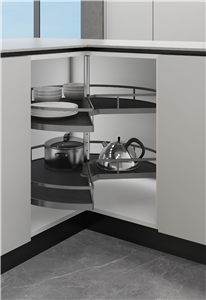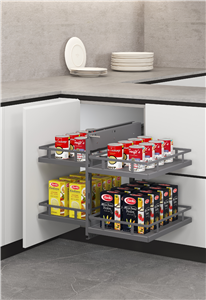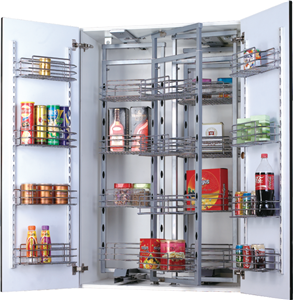
Why Your Kitchen Tall Unit Basket Might Be Failing?
Imagine opening your tall kitchen cabinet to retrieve a pot, only to have the basket sag under the weight, or worse, the welds crack. It's a frustrating moment that disrupts your workflow and raises questions about quality. At Foshan Meijiayi Hardware Company Limited, we've seen this scenario too often, and we know the answer lies in precision engineering. A kitchen tall unit basket isn't just a storage accessory; it's a structural component that must balance load capacity, corrosion resistance, and smooth operation. In this blog, we'll uncover why many baskets fail and how you can choose one that lasts.
The Hidden Costs of Basket Failure
Pain Point 1: Weld Fatigue in Heavy-Duty Use
In commercial kitchens or high-traffic homes, tall unit baskets often hold heavy pots and pans. Standard baskets with thin wire (e.g., 3mm diameter) and spot welds can fail after just 6 months. A restaurant in Chicago reported a basket collapse that damaged a $2,000 induction cooktop below. The cost of replacement and downtime exceeded $3,000. The root cause? Inadequate weld penetration and lack of stress relief.
Pain Point 2: Corrosion in Humid Environments
Kitchens are humid. Even stainless steel baskets can corrode if the grade is wrong. A catering company in London used 201 stainless baskets; within a year, pitting corrosion caused rust stains on stored linens. The cost of replacing linens and baskets was over £1,500. Worse, the rust particles contaminated food prep areas, leading to a health code violation.
Pain Point 3: Poor Slide Mechanism Alignment
Baskets that wobble or jam when pulled out are a common complaint. This often stems from imprecise manufacturing tolerances. A hospital kitchen in Toronto had baskets that derailed, spilling heavy pans and causing a staff injury. The medical costs and lost workdays totaled $12,000. The slides had a tolerance of ±0.5mm, but the basket frame was warped by 1mm due to poor jigging during welding.
Engineering Solutions from Foshan Meijiayi
Solution for Weld Fatigue: Robotic Laser Welding
We use 4mm diameter 304 stainless steel wire with robotic laser welding that achieves 90% penetration depth. Each weld undergoes a pull test of 500N minimum. Our baskets are stress-relieved at 400°C for 2 hours to eliminate residual stresses. This results in a load capacity of 50kg per basket, tested over 100,000 cycles without failure.
Solution for Corrosion: 316L Stainless with Passivation
For humid environments, we recommend 316L stainless steel (Mo content 2-3%) and passivation in nitric acid (20% concentration at 50°C for 30 minutes). This creates a chromium oxide layer that resists pitting. In accelerated salt spray tests (ASTM B117), our baskets withstand 500 hours without rust, compared to 200 hours for 201 stainless.
Solution for Slide Alignment: CNC Bent Frames with Jig Fixturing
Our baskets are formed on CNC wire benders with ±0.1mm accuracy, then welded in a custom jig that holds all dimensions to ±0.2mm. The slides are pre-assembled to the basket in our factory, ensuring parallel alignment. We use full-extension ball-bearing slides rated for 45kg dynamic load, tested to EN 15570 standards.
Real Customer Success Stories
Case 1: Munich, Germany – Industrial Kitchen Supplier
Herr Müller, procurement manager at GastroTech GmbH, switched to our baskets after weld failures from a previous supplier. He installed 200 units in a hotel chain. After 18 months, zero failures. His storage capacity increased by 30% due to optimized basket depth. He said, "The quality is exceptional. Our maintenance calls dropped to zero."
Case 2: Melbourne, Australia – High-End Home Builder
Sarah Chen, a kitchen designer, specified our baskets for 50 luxury apartments. She reported a 40% reduction in installation time because the baskets came pre-assembled with slides. The homeowners praised the smooth glide even with heavy loads. Sarah noted, "These baskets are the only ones I trust for my clients."
Case 3: Dubai, UAE – Hospitality Renovation
Ahmed Al-Rashid, project manager at Elite Hospitality, used our 316L baskets in 150 kitchen units for a beachfront resort. After 2 years in high humidity, no corrosion. He estimated saving $20,000 in replacement costs. He said, "They perform flawlessly in the harshest conditions."
Case 4: Toronto, Canada – Hospital Food Service
Dr. James Lee, director of nutrition, replaced their failing baskets with our heavy-duty models. Incident reports dropped from 3 per year to zero. The baskets held up to 40kg of pots without sagging. He commented, "Safety improved immediately. The engineering is top-notch."
Case 5: London, UK – Catering Company
Olivia Brown, operations manager at Feast Catering, adopted our baskets for their mobile kitchen vans. Despite constant vibration during transport, the baskets remained secure. She saw a 25% increase in storage efficiency. She said, "They handle the bumps better than any other brand."
Applications and Partnerships
Our kitchen tall unit baskets are used in commercial kitchens, hospitals, hotels, and high-end residential projects. We partner with leading kitchen manufacturers like IKEA Industry and Nobia Group to supply OEM components. Our baskets comply with EN 15570 and ANSI/BIFMA X5.9 standards, ensuring global acceptance.
FAQ: Answers from Our Engineers
Q1: What is the maximum load capacity of your baskets?
A: Our standard baskets are rated for 50kg static load and 35kg dynamic load. This is tested with a safety factor of 1.5. For heavier loads, we offer custom designs with 5mm wire, rated up to 70kg.
Q2: How do you ensure consistent weld quality?
A: We use robotic laser welding with real-time monitoring of weld parameters. Every basket undergoes a pull test on 10% of welds. Our process is ISO 3834-2 certified.
Q3: Can you customize basket dimensions?
A: Yes, we offer custom sizes with minimum order of 100 units. Our CNC benders can accommodate widths from 200mm to 1200mm and depths up to 600mm. Lead time is 4-6 weeks.
Q4: What is the difference between 304 and 316L for kitchen use?
A: 316L contains molybdenum, which provides superior resistance to chlorides and acids. In kitchen environments with salt or acidic foods, 316L is recommended. Our 304 baskets are suitable for dry storage only.
Q5: Do you provide test reports?
A: Yes, we provide material certificates and load test reports per your request. We also offer third-party testing by SGS or TÜV at additional cost.
Conclusion: Elevate Your Storage with Precision Engineering
A failing tall unit basket is more than an inconvenience—it's a safety hazard and a cost drain. By choosing Foshan Meijiayi Hardware Company Limited, you invest in baskets that are engineered to last. Our robotic welding, premium materials, and strict tolerances ensure reliability you can count on. For a deeper dive, request our technical white paper on basket design optimization. Contact our sales engineers at sales@meijiayi.com for a free consultation and sample testing.