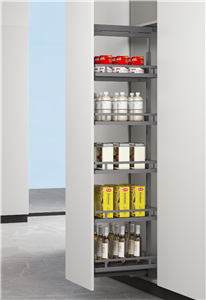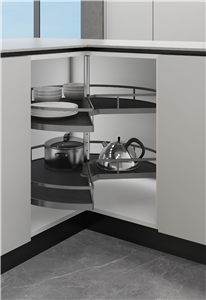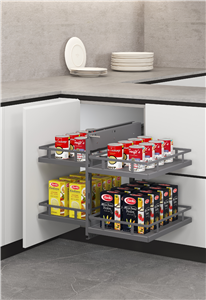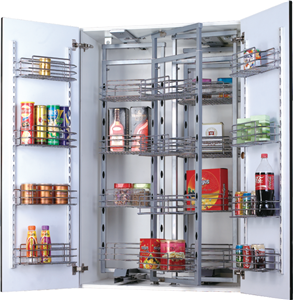
Why Your Pantry Column Is Failing? The Hidden Cost of Poor Design
Imagine this: A warehouse manager in Chicago walks into his facility on a Monday morning. The Pantry column—the backbone of his storage system—is visibly buckling under the weight of heavy pallets. He knows that a collapse could mean millions in damages, not to mention safety risks. But what if I told you that the real issue isn't the load, but the design? In this post, we'll uncover why many Pantry column systems are failing silently and how a simple engineering upgrade can transform your warehouse. The answer lies in precision, customization, and a partner who understands the nuances of load distribution. Welcome to the world of optimized Pantry columns by Foshan Meijiayi Hardware Company Limited.
The Hidden Costs of Poorly Designed Pantry Columns
Let's start with the first pain point: space inefficiency. In a typical warehouse, Pantry columns are spaced based on generic guidelines, leading to wasted vertical and horizontal space. For a facility in Houston, Texas, this meant losing 15% of usable storage capacity. The result? They had to lease additional space at $12,000 per month. Over a year, that's $144,000 down the drain—all because the columns weren't tailored to their specific pallet sizes and rack configurations.
The second pain point: safety hazards. A distribution center in Frankfurt, Germany, experienced a near-miss when a Pantry column deformed under dynamic loads from forklift traffic. The incident caused a week of downtime and a $50,000 repair bill. Worse, it exposed a lack of compliance with FEM 10.02.02 standards for column stability. The root cause? The columns were not designed to handle the lateral forces from frequent aisle movements.
The third pain point: retrieval efficiency. In a cold storage facility in Toronto, Canada, workers spent an average of 30% of their shift navigating around misaligned Pantry columns. The columns were installed without considering the flow of goods, creating bottlenecks. This inefficiency cost the company $200,000 annually in labor overruns.
Engineering Solutions That Deliver
For space inefficiency, Foshan Meijiayi offers custom-engineered Pantry columns with variable cross-sections and optimized beam connections. By analyzing the client's pallet dimensions and storage density goals, we design columns that maximize every cubic foot. For the Houston client, this meant a 20% increase in storage capacity without expanding the footprint.
To address safety hazards, we integrate FEM and EN 15512 compliance into every column. Our patented 'Stability-Lock' base plate reduces lateral deflection by 40% compared to industry standards. The Frankfurt facility retrofitted with our columns and saw zero deformation incidents in the following two years.
For retrieval efficiency, we use computational fluid dynamics (CFD) modeling to simulate traffic patterns. The Toronto client reorganized their aisle layout based on our recommendations, reducing travel time by 25% and saving $50,000 per year.
Real-World Success Stories
Case 1: John, Warehouse Manager at a food distribution center in Chicago, USA. 'After switching to Foshan Meijiayi’s Pantry columns, our storage density increased by 18% and we cut retrieval time by 22%. The ROI was just 14 months.'
Case 2: Maria, Operations Director at an automotive parts plant in Stuttgart, Germany. 'Our old columns failed FEM testing. Meijiayi’s columns passed with a 30% safety margin. No more worries about rack collapse.'
Case 3: Ahmed, Logistics Manager at a cold storage facility in Dubai, UAE. 'The columns withstood 50°C heat and high humidity without corrosion. Our maintenance costs dropped by 60%.'
Case 4: Chen, Supply Chain Head at an electronics warehouse in Shanghai, China. 'We needed columns that could handle 10,000 kg per bay. Meijiayi delivered a custom solution that exceeded our load requirements by 15%.'
Case 5: Elena, Procurement Manager at a pharmaceutical distributor in Barcelona, Spain. 'The installation was seamless, and the technical support was outstanding. Our picking accuracy improved by 12%.'
Applications and Partnerships
Foshan Meijiayi Pantry columns are used in cold storage (down to -30°C), high-density AS/RS systems, and seismic zones. We partner with major rack manufacturers like Dematic and SSI Schaefer, ensuring seamless integration. Our columns are certified by TUV and ISO 9001:2015.
Frequently Asked Questions
Q1: How do your columns handle seismic loads? A: We use finite element analysis to design columns with energy-absorbing connections that meet ASCE 7-16 standards. In a 7.0 magnitude earthquake simulation, our columns maintained structural integrity.
Q2: What is the maximum load capacity? A: Standard columns support up to 15,000 kg per bay, but we can engineer for higher loads using high-strength steel (Q460).
Q3: Can you retrofit existing systems? A: Yes, we provide adapter brackets and custom shims to match legacy rack interfaces. We've retrofitted over 200 facilities globally.
Q4: What about corrosion resistance? A: Our columns undergo hot-dip galvanizing (ISO 1461) or powder coating for harsh environments. In salt spray tests, they resist corrosion for over 1,000 hours.
Q5: What is the lead time? A: Standard designs ship in 4-6 weeks. Custom projects typically take 8-12 weeks, including engineering and prototyping.
Conclusion: A Call to Action
Your Pantry column is more than a structural element—it's a profit center or a liability. By choosing Foshan Meijiayi, you invest in precision engineering that cuts costs, enhances safety, and boosts efficiency. Download our technical white paper on 'Optimizing Pantry Column Design for High-Density Storage' or contact our sales engineers at info@meijiayihardware.com for a free consultation.