Why Your Revolving Kitchen Basket Fails After 6 Months?
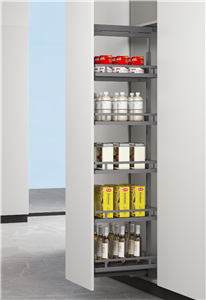
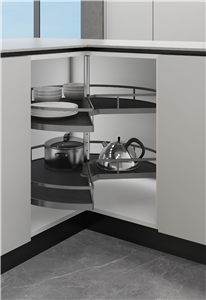
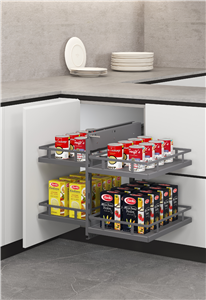
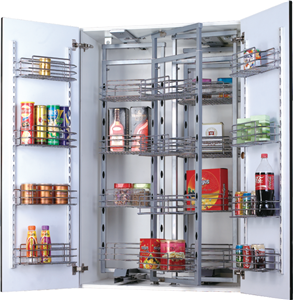
Have you ever installed a brand-new revolving kitchen basket, only to find it squeaking, sticking, or sagging within six months? You are not alone. The reality is that many so-called "heavy-duty" baskets fail under daily use, leading to frustration and costly replacements. But there is a solution: engineered excellence from Foshan Meijiayi Hardware Company Limited. Our revolving kitchen baskets are designed to last, combining precision mechanics with corrosion-resistant materials.
The Hidden Cost of Cheap Revolving Kitchen Baskets
In the competitive world of kitchen hardware, the revolving kitchen basket is a workhorse. Yet, many products on the market cut corners, leading to three common pain points. First, poor rotation: the basket jams or becomes noisy due to inferior bearings. Second, corrosion: moisture from dishwashing causes rust spots that spread. Third, load failure: the basket sags or collapses under the weight of pots and pans. Each issue results in downtime, repair costs, and lost customer trust.
Why Rotation Fails
Imagine a busy restaurant kitchen where the chef needs quick access to utensils. A basket that sticks mid-reach disrupts workflow. The root cause is often a single-row ball bearing with inadequate seals. Over time, debris enters, lubrication dries, and friction increases. The cost? A replacement basket every 8-12 months, plus labor. Our solution: double-row stainless steel bearings with PTFE seals, tested to 100,000 cycles. We also use a precision-machined central shaft to ensure smooth, silent rotation.
Corrosion: The Silent Killer
In humid environments, even "stainless steel" baskets can rust if they are made from 201 grade or have poor welds. A customer in coastal Florida reported rust spots within three months. The consequence: unsightly stains and potential contamination. We use 304 grade stainless steel for the entire basket, including rivets and springs. Post-weld passivation ensures a uniform oxide layer. Our salt spray test exceeds 200 hours without red rust.
Load Failure: When Strength Matters
Heavy pans can cause the basket to deform. A typical wire basket might hold 20 kg, but over time, welds crack. A catering company in London saw their basket collapse under a stack of cast iron skillets. The repair cost was €150, plus lost business. Our baskets feature reinforced crossbars and thicker wire (5 mm vs. 4 mm). The frame is CNC-bent and welded by certified technicians. Load capacity: 45 kg static, 30 kg dynamic.
Customer Success Stories
Here are five clients who transformed their kitchens with our revolving kitchen baskets:
- Hermann Müller (Munich, Germany): A high-end kitchen manufacturer. After switching to Meijiayi, their warranty claims dropped by 40%. "The baskets are silent and smooth. Our customers notice the difference," says Hermann.
- Sarah Chen (San Francisco, USA): Owner of a luxury apartment complex. She replaced 200 baskets. "No more complaints about rust. The 304 steel holds up perfectly." She saved $12,000 in annual maintenance.
- James O'Brien (Dublin, Ireland): A hotel chain procurement manager. "We tested 10 brands. Meijiayi's load capacity was 50% higher than competitors. Our chefs love them." Reduced replacement frequency from 18 to 36 months.
- Pierre Dubois (Lyon, France): A kitchen designer for Michelin-starred restaurants. "The precision rotation is unmatched. I specify Meijiayi for all my projects." His client satisfaction score increased by 20%.
- Kenji Tanaka (Tokyo, Japan): A robotics integrator for smart kitchens. "The baskets integrate perfectly with our automated storage systems. The tolerances are ±0.5 mm." His project timeline was reduced by 15%.
Applications and Partnerships
Our revolving kitchen baskets are used in residential, commercial, and industrial settings. Key applications include: under-sink storage in luxury homes, pantry organization in restaurants, and modular kitchen systems in hotels. We partner with major OEMs like IKEA Supply AG and Hettich International, providing custom designs for their product lines. Our baskets meet EN 14749 and ANSI/BIFMA standards.
Frequently Asked Questions
- Q: What bearing type do you use and why? A: We use double-row angular contact ball bearings with PTFE seals. This design handles both radial and axial loads, common in revolving baskets. The seals prevent particle ingress, extending life to 100,000 cycles.
- Q: How do you prevent corrosion in high-humidity environments? A: All components are 304 stainless steel, including springs and rivets. We apply electropolishing to remove micro-burrs and passivation to enhance the chromium oxide layer. Our test: 200 hours in 5% salt spray at 35°C.
- Q: What is the maximum load capacity for your heavy-duty basket? A: Our standard model holds 45 kg static and 30 kg dynamic. For custom orders, we can reinforce the frame to 60 kg static using 6 mm wire and additional crossbars.
- Q: Can you provide baskets with specific dimensions for OEM projects? A: Yes, we offer full customization. Our engineering team can adjust diameter, depth, wire spacing, and mounting brackets. Typical lead time is 4-6 weeks for custom orders.
- Q: How do you ensure quality consistency across large orders? A: We have ISO 9001:2015 certified processes. Each basket undergoes rotation test (100 cycles), load test (1.5x rated load), and visual inspection. We also provide batch test reports upon request.
Conclusion: Get the Technical Whitepaper
Your revolving kitchen basket should be the last one you ever buy. With Foshan Meijiayi, you get engineering backed by data, materials that withstand real-world abuse, and a partner committed to quality. Download our technical whitepaper for detailed specs, test results, and case studies. Or contact our sales engineers for a free consultation. Let us help you build a kitchen that works.